What I Saw in England (Part 6)
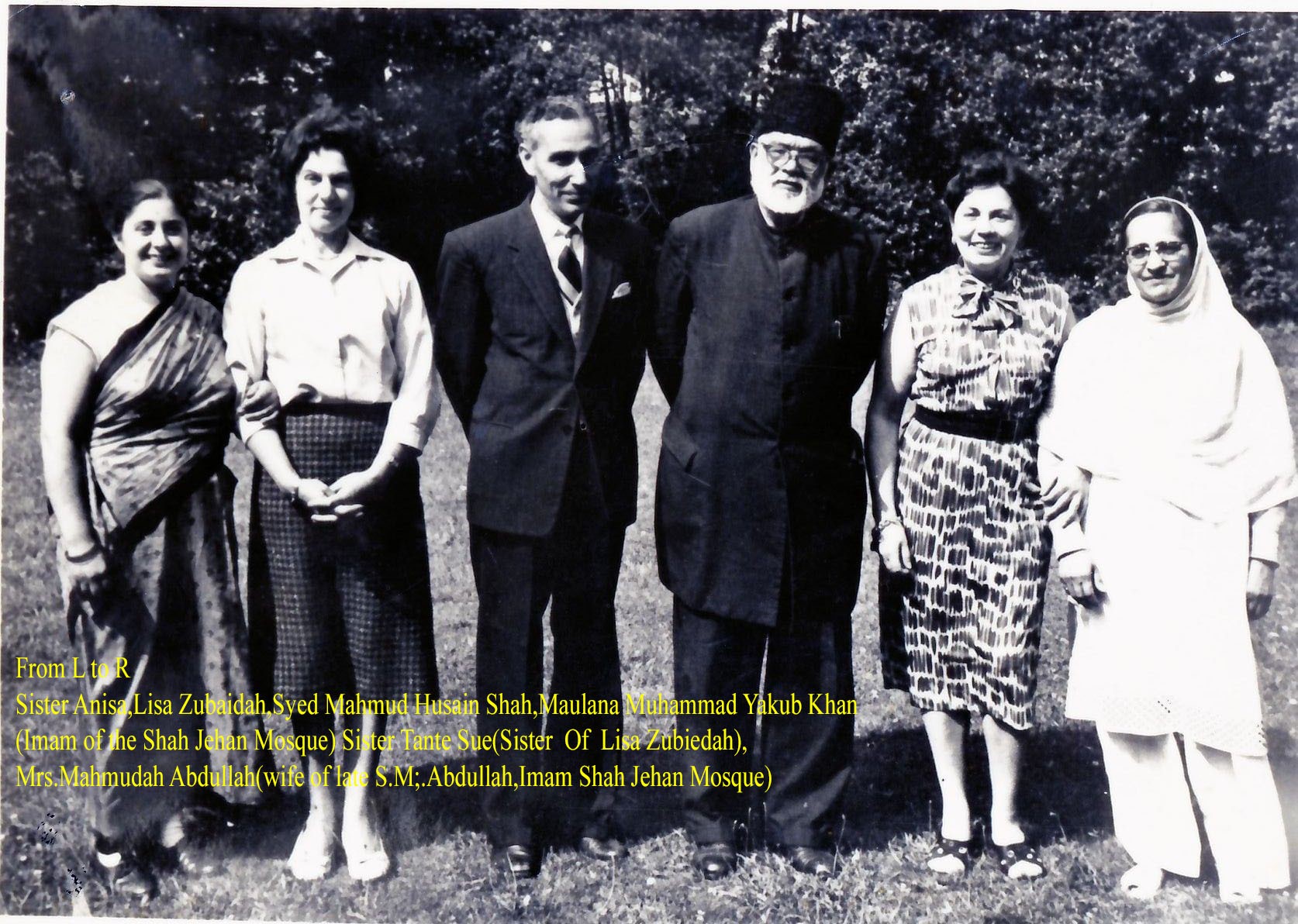
Imam, The Woking Mosque with visiting dignitaries
Growing Assimilation of Islamic Principles – Divine Unity Sweeping Western Religious Thought – Salvation in the Islamic Sense of living up to Jesus’ Example – Indivisibility of Religious Truth.
The estrangement, even animosity, between Islam and Christianity, in the fields both of religion and politics, has been entirely a one-way traffic. It was the Church which whipped up the anti-Muslim sentiments in the Middle Ages and made Crusaders from the remotest parts of Europe leave their homes, march hundreds of miles to wrest the Holy Land from the “infidels”. The Caliphate had to play the defensive role.
As a religion also Islam, at its very inception, extended a hand of fellowship towards other revealed religions, especially Christianity whom the Quran describes as the nearest to Muslims in sympathies because of the presence in their midst of God-fearing men devoted to the worship of God. The founder of Christianity has been referred to in most glowing terms as God´s chosen prophet, gifted with spiritual powers of a very high order. The hadith also pays a great tribute to “Jesus, son of Mary” when it foretells his coming in the latter days for the regeneration of a fallen humanity. Even the Ahmadiya interpretation that the promised reappearance of Jesus, was meant to be in spirit, not in flesh, in no way detracts from the compliment.
Nevertheless, what has been the reaction of the Church to all these friendly gestures on the part of Islam. Paradoxically, it has throughout history looked upon this most friendly religion as its enemy No. 1, painting it in most lurid colours as a cult of barbarism, lust and all sorts of savagery.

Professor Arthur John Arberry
Prof. Arthur John Arberry, in his Preface to his English Translation of the Quran traces how this deep-seated hatred of Islam of the Christian mind reflected itself in the various translations of the Quran in European languages from the earliest times, and how, gradually, the hatred went on toning down , being replaced by appreciation, even admiration. The earliest translations, he tells us, had to offer an elaborate apology to his readers for the “offence” to their religious sense by introducing to them that “falsehood.”
He did so, he explained, so that good Christians might be in a better position to rebut those “falsehood” and “fabrications”.
This attitude of rank hostility, however, gradually underwent change and succeeding translators, better equipped with knowledge of Arabic, brought a comparatively better approach to bear upon their task. In his own case, the Cambridge Professor tells us, he was charmed by the early morning recital of the Quran by a Muslim neighbour during his sojourn in Egypt that he made up his mind to capture something of the rhythm of the Book which constituted to much of its force and beauty, but which had been missed in various translations.
The appreciative approach reflected in Arberry´s translation may be taken to be more or less typical of present-day Western scholarship. One of the latest and most pronounced move in this direction, as referred to in the last instalment, comes in the form of Dr. Cragg´s book, The Call from Minaret, wherein the author roundly deplores the medieval folly when Crusaders from Europe marched out to win a strip of territory in the name of Jesus Christ but in the process, losing that holy personality and its significance to Muslims. The second impact between Christianity and Islam which Dr. Cragg considers as most deplorable has been that of Western colonialism which gave the world of Islam quite a distorted picture of Christianity and led to further estrangement between Christians and Muslims. He makes a strong plea for better understanding of each religion by the other.

Kenneth-Cragg
Dr. Cragg even goes to the extent of complaining that Muslims should seriously attribute the creed of Trinity to Christianity. Christianity, he declares, is as much wedded to the unity of Godhead as Islam, the Son and Holy Ghost being no more that certain relationships of God towards man – something like the attributes of Rahman and Rahim associated with Allah in Islam.
This is no small step which conventional Christianity has taken in the direction of Islam. Unity of God is the bedrock on which stands the whole edifice of Islam. Liberal Christian thought is gradually veering round towards that position, discarding or explaining away the traditional creed of Trinity. Jesus´s sonship is no longer seriously taken as meaning anything more than sonship in the moral and spiritual sense. That is a position by no means at variance with the Islamic thought which looks upon all Prophets and holy men as being metaphorically God´s sons.
One by one creedal gulfs that have so far intervened between Islam and Christianity are being bridged. Even the salvation value of faith in Jesus is becoming comprehensible to the Western mind in the Islamic sense. Let me illustrate this from personal experience.

Sir Salar Jung Memorial Hall – Imam´s Residence & The Woking Mosque
One day after sunset when I returned from London and was walking along from the Woking railway station towards the Mosque, a man who was cycling along the road from behind got down as he saw me and came up to me. He was a workman going back home after his day´s work. “I have often thought of coming down to the mosque”, he said, “to clear up certain points. How can salvation be at all possible without faith in Jesus Christ?” His surprise knew no bounds when I told him that we also held the same view and considered faith in Jesus Christ essential for salvation. Our only difference with the Christians in this respect was, I explained, that we took faith-in-Jesus in the sense of following in the footsteps of that Prophet of God, whereas the Christians interpretation amounted to absolving mean of that obligation.
A new view of Jesus` salvation role seemed to dawn on him, and he himself recalled several quotations from the Gospels wherein good life and observance of the commandments had been made indispensable for entering the Kingdom of Heaven. Everywhere when in a private conversation or at a public meeting I was asked this question, I gave this Islamic interpretation of salvation and I could see that it went home directly.
Like the rest of religious concepts, Islam has rationalised the significance of salvation which all religions, in one form or another, proclaim to be their objective. It has exploded the mechanical conception of this human aspiration, whether in the sense of escapism from life, its problems and challenges as in Hinduism and Budhism with their emphasis on renunciation and mortification of the flesh or in that of vicarious atonement as in Christianity or the institution of Pir-Murid commonly in vogue among Muslims.
The only salvation known to Islam is that of self-development, self-ennoblement, self-sublimation for which life and its vicissitudes and ordeals are but an indispensable breeding ground. But for the fire of Nimrud, Abraham would not have risen to the spiritual eminence he attained to. The brightest gem in Jesus’ crown of greatness lay in his crown of thorns and cross. The Prophet Muhammad ﷺ had to go through the worst fury of his people´s persecution to bring out the finest mettle in him. This is an interpretation of salvation which stands to reason, and which is another great contribution of Islam towards the rationalisation of religion.
This Islamic concept is also steadily swaying the Western mind, thereby eliminating another dividing factor between Islam and Christianity. If Christianity means living up to Jesus’ example, a Muslim cannot but say Amen to it, because that is what his Quran enjoins him to do – viz., to walk in the footsteps of all the chosen Prophets of God without distinction.
Here again Islam alone provides a common meeting ground for the world´s revealed religions. Christian religious thought in the West is already reorientating in every belief of concept that matters in religion along the broad outlines laid down in the Quran. The absurdity of making religious truths the monopoly of the Church, the wide acceptance of Divine unity, the interpretation of Jesus´ sonship as a mere metaphorical expression, the replacement of the atonement idea of salvation by that of example-to-be-followed – these new trends noticeable in Western religious thought bear such a distinct Quranic imprint. The present-day Orientalists and Churchmen, brought up in the liberal, objective traditions of a scientific age cannot but visualise the dawn of a new era when Islam and Christianity, rather than think and feel in terms of two camps, must rediscover their common origin, the common Truth their Founders stood for and pursue a common destiny.
Barriers in human thought and sympathies are fast crumbling at the touch of the new age in the sphere of religion as in that of geography, politics, economy, and war and peace. Just as indivisibility of war, peace and prosperity are being universally recognised as the inevitable trends of the new age, so is the indivisibility of religion.
Islam proclaimed this truth of religious indivisibility fourteen centuries ago. And slowly but steadily as this great truth goes on dawning on the Western mind, Islam and Christianity are bound, sooner or later, to emerge as comrades rather than foes, in a common cause. Western thought, religious as well as secular, is already showing strong trends in that direction.
(From The Light – March 8, 1958 (To be continued)