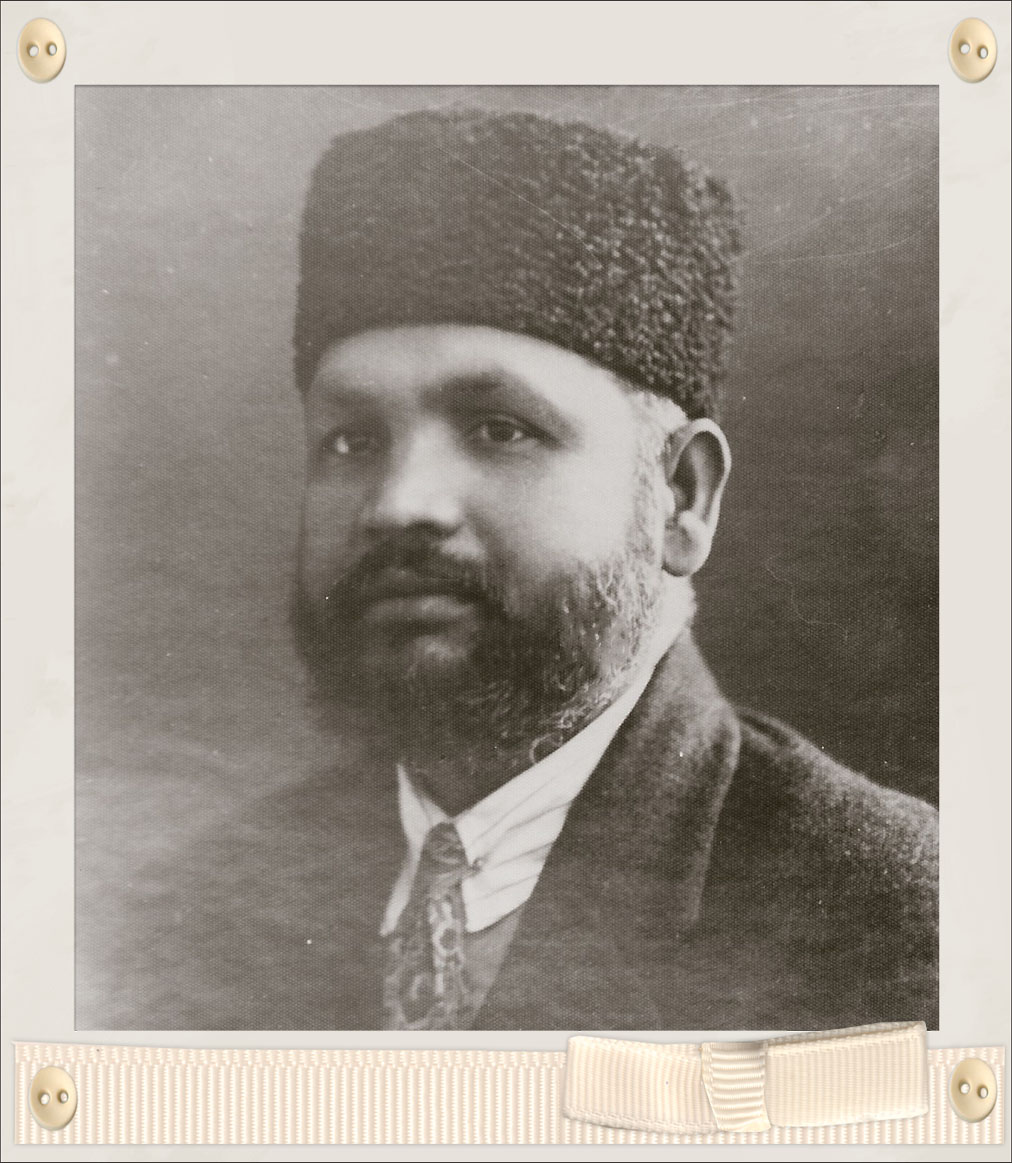
THE STAR THAT SHED LIGHT AND LUSTRE
THE Holy Quran likens the advent of a man or Heavenly light to the life-giving showers of rain which, the moment they touch the dead sod breathe into it an uncanny message of a new life after the lighting and withering bleakness of autumn and lo the dead earth is quickened to life in all the brilliance and richness of verdure and colour and fragrance. Hazrat Mirza Ghulam Ahmad, the God-commissioned man for the regeneration of this spiritually dead and decadent age was one such mighty phenomenon who by his mere contact transformed, men of common clay into angels and supermen. In the storm of opposition that was raised against him he advanced this fact as one of the arguments in support of his Divine mission, viz., that at his touch the garden of Islam had been resurrected to a new life:
کنون کہ در چمن من ھذار گل بشگفت
گر از طلب بہ نشینی عجب خطا باشد
”To-day when a thousand flowers have blossomed in my garden, what a folly that you should turn away from its quest.”
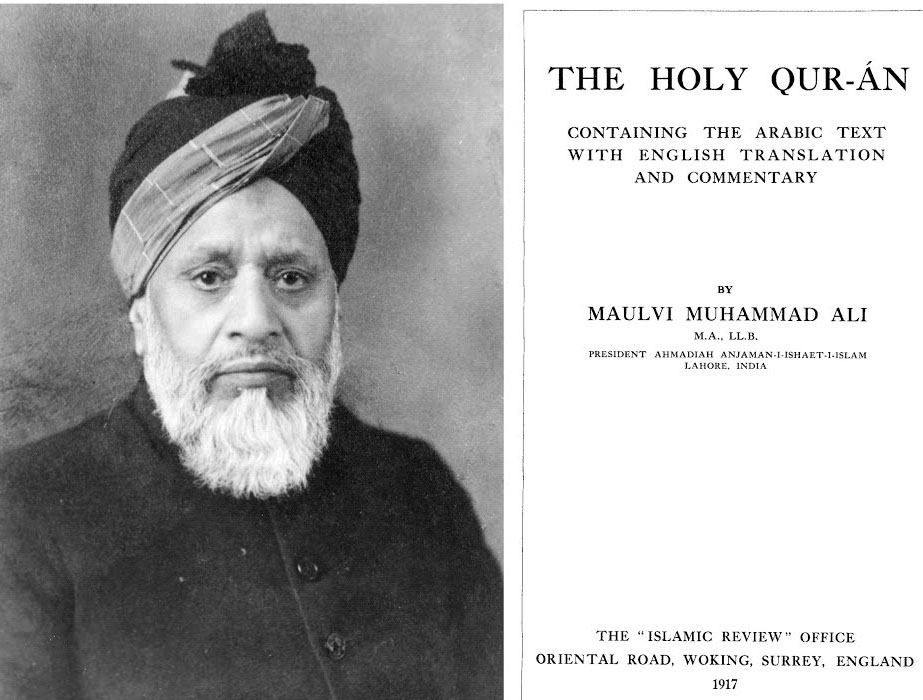
Maulana Muhammad Ali (1874 – 1951) was one such flower and a big one too in this garden of Islam which was brought back to life under the direct breath of Heaven. I have often wondered at the apathy of Muslim brethren towards this standing miracle of the man who was depicted by the Prophet ﷺ himself as the bringer of the lost faith from the Pleiades. What more proof do they need of his righteousness, I often ask myself, other than the good Godly noble souls that he was instrumental in producing—men in our own sphere like Khwaja Kamal-ud-Din, Sheikh Rahmatullah, Maulana Ghulam Hasan Khan, Mirza Yaqub Beg, Syed Muhammad Husain Shah, Mian Ghulam Rasul and now the last of this noble band Maulana Muhammad Ali. Was not each one an argument in flesh and blood proclaiming the Divine source of the fountain at which each drank deep and became instinct with a new life? Within them burnt the flame of faith. To see them was to feel the light and warmth of faith they radiated.
The Holy Prophet ﷺ likened his companions to the twinkling stars on the firmament of life any one of which could light the path of the seeker after truth. The same applies on a smaller scale to those who came into contact with the Seer of Qadian. Maulana Muhammad All was one such big star that has just set after shedding his lustre to the four corners of the world.
Momentous Choice
Fifty years ago when in the full bloom of youth, equipped with the highest academic distinctions, M.A. and LL.B. – degrees considered to be a passport to a life of comfort, power and plenty – the young Muhammad Ali fell under the spell of this strange “kafir” of Qadian, as Mirza Ghulam Ahmad was described by the so-called orthodoxy and so utterly lost was he to world with all its charms that he never for a moment spared a glance back at the rosy prospects that he left behind. It seemed as if he had come by some Heavenly bliss at the feet of the Master before which every attraction paled into insignificance. Fifty years is a long time – 600 months, 18000 days and 432000 hours – and it is staggering to think that all these long months and days and hours he was haunted by the one all-dominating passion: the revival of the faith of Islam and the restoration of its lost glory. No fluctuations of fortune, in his individual life or in the social or political set-up around him could in the least disturb or distract his mind from the main object of his pursuit – the unfolding of the lovely face of Islam for all the world to behold. Like every mortal he had his share of human sorrows and sufferings; he also had his moments of ease and prosperity. But waves of adversity and prosperity beat against his Himalayan immovability equally in vain and in the midst of these he stood calm and serene, unruffled, unperturbed and unconcerned.
The Path of Faith
The Quran depicts the life of a man of faith in the words:
لَآ إِكْرَاهَ فِى ٱلدِّينِ قَد تَّبَيَّنَ ٱلرُّشْدُ مِنَ ٱلْغَىِّ فَمَن يَكْفُرْ بِٱلطَّـٰغُوتِ وَيُؤْمِنۢ بِٱللَّهِ فَقَدِ ٱسْتَمْسَكَ بِٱلْعُرْوَةِ ٱلْوُثْقَىٰ لَا ٱنفِصَامَ لَهَا وَٱللَّهُ سَمِيعٌ عَلِيمٌ
Al-Baqara (The Cow) 2:256
“Whoever has faith in God and breaks away from the Devil, so surely he has laid a grasp on a firm handle which knows no breaking.”
Elsewhere a life of faith is described in the words:
إِنَّ ٱلَّذِينَ قَالُوا۟ رَبُّنَا ٱللَّهُ ثُمَّ ٱسْتَقَـٰمُوا
Fussilat (Explained in Detail) 41:30
”Surely those who say: Allah is our Lord and then stand fast”.
Maulana Muhammad Ali’s life was a typical demonstration in our times of this Quranic description. Once he took the supreme decision to dedicate his life to God, he allowed nothing to stand in his way or disturb the even tenor of his life, hitched to an all-consuming life-mission to exalt the glory of God on earth.
I happened once to occupy a house in his neighbourhood in the Ahmadiyya Buildings. One night in domestic worry I went to seek his assistance. As I went up to his room, I found him sitting on the floor by the bedside of his ailing daughter in the last stages of tuberculosis. This went on night after night. By day he attended to his work, by night he attended to his fast-sinking daughter. This shows the depth of his parental affection and his high sense of duty towards his dependents. When, however, the girl passed away he was so calm and composed as if nothing had happened. This impressed me with the Quranic description:
أَلَآ إِنَّ أَوْلِيَآءَ ٱللَّهِ لَا خَوْفٌ عَلَيْهِمْ وَلَا هُمْ يَحْزَنُونَ
Yunus (Jonah) 10:62
”Verily, the friends of God have neither fear to weigh upon them nor do they have to grieve.”
Humility Personified
Maulana Muhammad Ali’s unshakable steadfastness in the path of Islam was equalled only by his profound sense of humility. By common consent, for his scholarship of Islam and the heaps of Islamic literature with which he flooded the world he came to command an international fame. Many of his works on Islam were translated in various Muslim countries in their own languages. In Turkey the Sheikh-ul-Islam in person rendered some of his books into Turkish. His death created a stir throughout the world of Islam and the news was broadcast by prominent radio stations the world over. With all this greatness and glory however, he was the embodiment of humility, the hallmark of all true greatness. In his dress, in his general address, his talk, even in his public speeches he was singularly free from the least touch of affectation, ostentation or the cheap platform technique to create a dramatic effect. The force of his personality and utterances lay in his downright sincerity coupled with a keen insight into the deepest depths of the Quranic lore. He was not the kind of a superficial man who, like a shallow hill brook makes a tumultuous display of his little knowledge. Of him it might be truly said that deep waters run still, and his demeanour in all his dealings was marked by a quiet unassuming dignity. Of his depth of Quranic knowledge, the late Hazrat Khwaja Kamal-ud-Din used to say he grew restive when he listened to a speaker on Islam because from his first sentence, he could foresee what he was going to say, but in case of Muhammad Ali he had to be all attention because every next sentence that he uttered disclosed some fresh viewpoint. The Quran describes men of deep erudition with a ripe judgment and all-comprehensive outlook as Rasikhoon-fil-ilm. Maulana Muhammad Ali undoubtedly falls under this proud category. With the light of faith kindled within him by the Mujaddid of the age he combined a deep insight into Quranic teachings but like a truly great man with all these distinctions he never gave himself airs nor cared for cheap applause. His humility, the dominant note of his personality, was best illustrated in his will wherein he expressed the desire to be buried “at the feet” of the friends with whom he had worked and spent a lifetime.
Level-headedness
The picture of the Maulana’s personality will be incomplete without a mention of another great quality – a unique balance of mind. He had nothing in common with the kind of a fanatic who sees only this side of the picture. His approach to all problems was truly scientific, taking an objective view of things, uninfluenced by personal likes or dislikes. He allowed neither passions nor prejudices to get the better of his judgment. His level-headedness was best illustrated when passions were running high as to the true position of the Founder of Ahmadiyya Movement in the light of his claims. Avoiding the two extremes he synthesised all the claims in the formula on which subsequently was founded the Lahore wing of the Ahmadiyya Movement – viz., that with all his spiritual stature making his acceptance a necessity for rekindling a spark of faith for which he was expressly commissioned in this age, the Founder was but a humble servant of the Holy Prophetﷺ whose rejection as such did not entail heresy (kufr). He always tried to see the good, in others, even those opposed to him and to frankly acknowledge it.
Untiring Labour
The other day I had a chance to have a look at the Maulana’s personal library at his Muslim Town residence. I felt overwhelmed by the amount of labour I found bestowed by him on the preparation of his Urdu commentary of the Holy Quran – Bayan-ul-Quran. There were three huge bundles of manuscripts running into thousands of pages which he scribbled in is own hand. The first one, when prepared, was given so many finishing touches and marginal corrections, additions, and alterations that the foolscap pages presented the appearances of one big parch of black. This necessitated a fair copy and the Maulana set out with his usual untiring vigour to reproduce every word of the hundreds of pages over again in his own hand. This fair copy was re-subjected to the process of retouching and re-polishing with somewhat similar result as before and it became necessary to prepare another fair copy to be placed in the scribes´ hand. It was this finished product, the outcome of three arduous attempts in is own hand, that finally emerged in print in the form of the three big volumes that constitute his monumental Urdu commentary the Bayan-ul-Quran.
Fifty years ago, when the Divine insight of the Mujaddid discerned in him the promise of great performances in the cause of Islam and. spotted in him the future standard bearer of Islam, evidently, as events testified, he must have had a glimpse of the manifold qualities of head and heart so happily blended in Maulana Muhammad All’s personality. It seems as if Providence had carved him for the express purpose and mission to implement the Promised Messiah’s programme of Islamic regeneration.
Maulana Muhammad Ali is no more in the flesh with us but his life, every day and hour of which he filled with solid work in the advancement of Islam, will serve as a beacon to all those privileged to trek along the same arduous but glorious path.
M.Y.K.
(THE LIGHT – January 1, 1952)