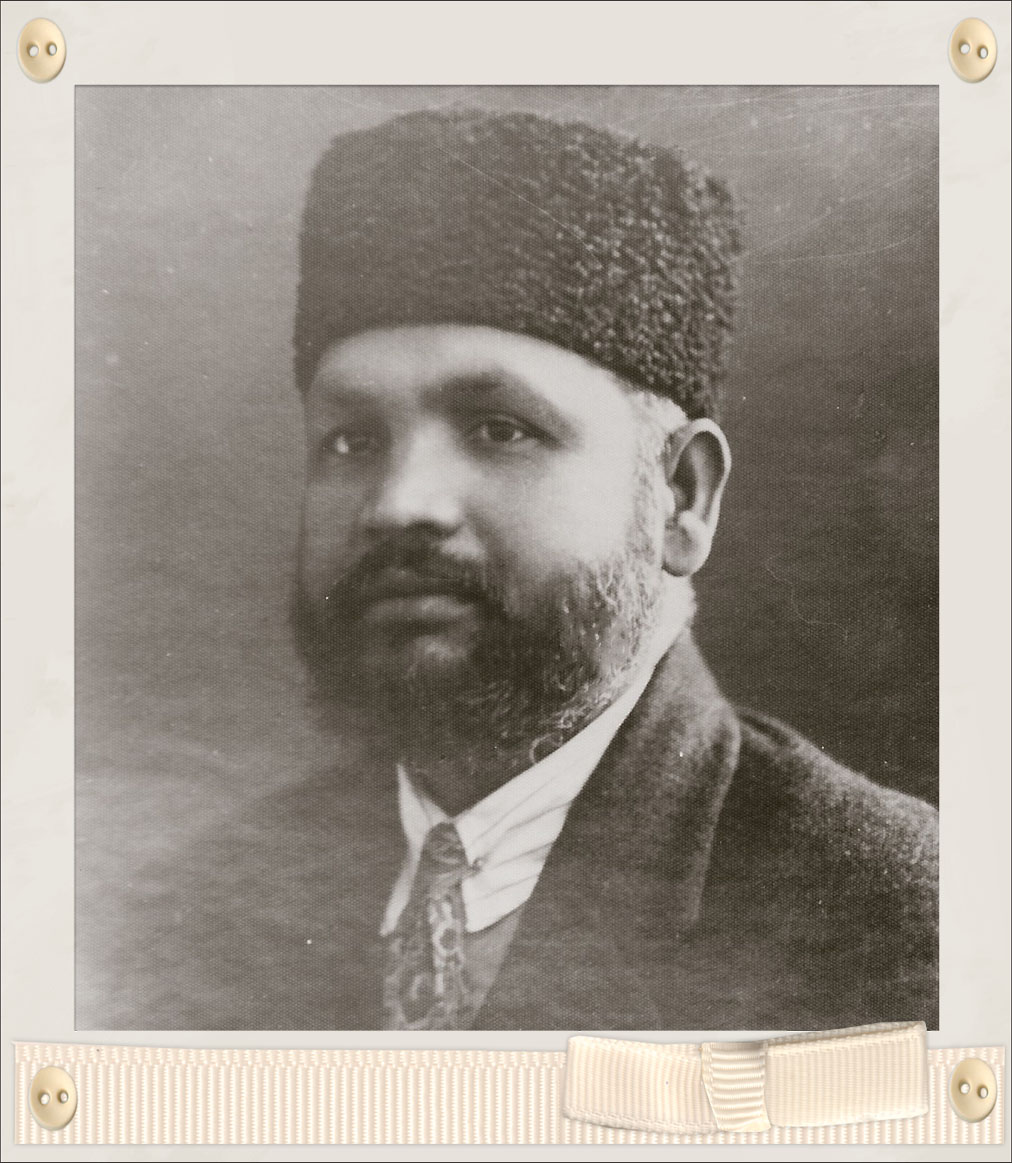
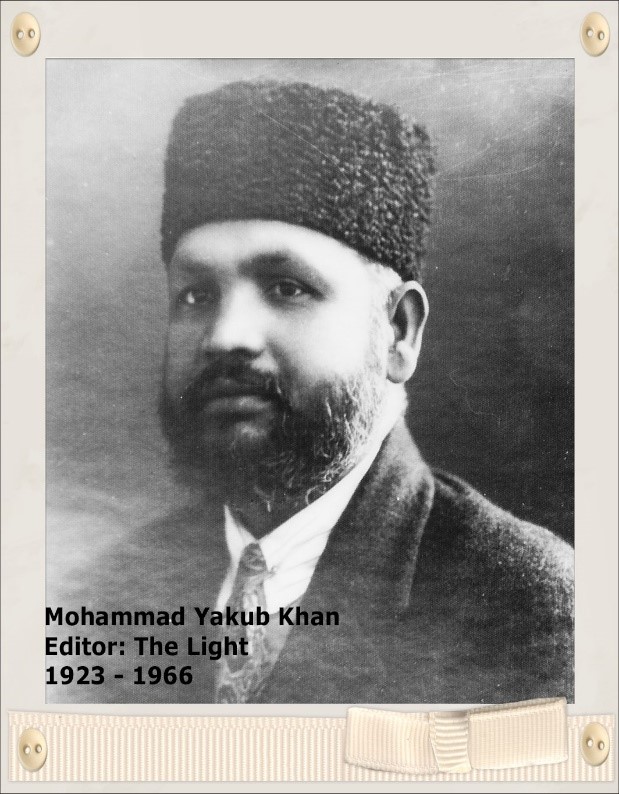
THE ARREST OF MAULVI MOHAMMAD YAQUB KHAN – PART 2
Thursday, the 13 October 1927
PROSECUTION OF THE LIGHT STAFF
STATEMENT OF MAULVI MUHAMMAD YAQUB KHAN
ED1TOR THE ” LIGHT.”
Q.Were you the Editor of the issues of the ” Light ”dated 16 August and 1st. September 1927?
A.Yes.
Q.Do you wish to say anything about the article ” Fight to the Finish ” as regards its tendency to create disaffection between Hindus and Muhammadans?
A.It does not create disaffection between Hindus and Mussalmans. I will submit a detailed statement.
Q.And as regards ” Every Hindu a Rajpal” and ”Confession of Crime”?
A.The same as said before.
Q.What was your intention in publishing these articles?
A.My intention as I will discuss in my written statement, was to bring out some of the main causes that are at present dividing the Hindus and Musalmans and to urge them upon the attention of both the communities and also to warn the Musalmans against what I consider to be aggressive mentality of the Hindu community.
Q.What do you mean by the heading ”Every Hindu a Rajpal”?
A.I have explained this in the note itself. It means only this that every educated Hindu who counts for anything is imbued with aggressive mentality towards the Muslaman community.
Q.Are you aware that Rajpal was a subject to particular hatred on the part of the Muslim community?
A. Yes.
Q.What do you mean by “Fight to the Finish ”?
A.I mean that the Mussalman community are very Slow and they are generally very slack in looking after their own commercial interest in order to protect them against aggressive mentality of the Hindus which aims at the establishment of Hindu Raj in India. I have only asked my community not to sit still but to be up and to adopt means and measures to legitimately defend their own interests.
Q.What did you mean Finish?
A.This was written after the Vartman judgment was pronounced and this was the time when the Mussalmans were likely to be lulled into the same indifferent attitude to watch their own interests. I have asked them to carry on defence of their interests as they did in the case of the ” Vartman” agitation.
Q.Are you aware that Abdur Rashid murdered Swami Shardhanand?
A.Yes.
Q.What it did you mean by the passage “Abdur Rashid is the logical product”. Every Muslim must be an Abdur Rashid up to the end of the article “Every Hindu a Rajpal”?
A.The meaning of this has been misunderstood and the hue and cry that has been raised in the Hindu press is mostly due to the misapprehension. This has been misconstrued as exhortation to every Mussalman to become an Abdur Rashid. This interpretation is not borne out by the context. In this note I have replied to a certain correspondent who says that every Hindu is not a Rajpal and every Muslim is not an Abdur Rashid. I have pointed out to him that his reading of the situation is not correct, that unfortunately every Hindu has become a Rajpal in the sense of being imbued with aggressive mentality against the Mussalmans and consequently the Mussalmans on an average have become more or less an Abdur Rashid in the sense that they are compelled to adopt measures to meet the impression. The words “must be” are not used in the sense of “should be” but in the sense of “has had to be”. I have explained this in the “Light” dated 9th.September 1927 on page 3 under the heading “An Explanation”.
Q.The passage in the “Fight to the Finish” paragraph 3, beginning “how to crush the monster, cut it clean through. Does it not advocate violence?
A.No. Nowhere in this article have I called a Hindu a monster. I have only been talking about the aggressive Hindu mentality and it is that that I compare to a monster and the mentality is never crushed with steel. This is only a metaphor which has no bearing on the monster, and this only amounts to saying that to deal with aggression one must have sufficient strength; similarly, the whole of this paragraph up to the end has nothing to do with what I want the Musslamans to do. It is only a general comment, a sort of digression, and when I actually come to suggest what the Musslamans should do and wherein that strength lies I nowhere mentioned “steel”. I only mentioned what Hindu Maha Sabha leaders have been mentioning from hundreds of platforms in the Punjab and outside, these are three things:
(1) Physical exercise,
(2) Economic uplift and
(3) Closing up of their rank i.e., to start what Hindu calls Sanghatan, to unite and to put up in intercommunal defence. This should make it clear to everybody that I did not advise any illegal application of force.
Q.In the last paragraph page 4: the passage “in arms day and night, arms of steel, arms of money, arms of organisation” Would you care to explain the meaning of the word “steel” here?
A.This is the exact reproduction of the same 3 items above. Steel here means strength. In the first line of this column on page 4, I have explained “steel” as strength.
Q.In the sentence “let your steel be bright” on page 3 in passage and ready quoted above, what do you mean by “steel” here?
A.By steel I did not mean weapon but strength, i.e., you must have strength, physical, economical and of organisation.
Q.Anything more to say?
A.As regards the intention it is clear that I have been preaching in this very issue of the “Light” such things as one God, one humanity, on page 5. The man who believes in the universal brotherhood of man as I do…( The last sentence was not legible due to faded print -SA)

THE LIGHT. SEPT. 16, 1927
The following article written by Moulvi Muhammad Yaqub Khan was given to the Press before he was arrested. It was printed in a Special Number called “The Prophet´s Birthday Number” published on the 9th September 1927. Only one hundred copies had been printed when the Editor, the published and the Printer were arrested.
AN EXPLANATION
Ever since the conviction of two Hindus in the ”Vartaman case”, Samajists and Sanghtanists, have been on the look-out for some sort of opportunity to avenge this by getting some Muslims into trouble. In their impatience they set to digging up old graves, calling Government’s attention to ”Chaudwin Sadi ka Mahrishi” and ”Delhi to Ahmadad”. When however, Sir John Maynard’s reply in the Council that these had caused no agitation, frustrated their very first attempt, they made up their mind to try this new method of agitation. Anything, they thought, was good enough for agitation and so long as there was enough of it, the Government could be coerced into proceeding against anyone. This newly forged weapon has been used against the issue of the “Light” of August 16 and used with a vengeance. The Government of India and the Punjab Government are said to have been flooded with telegrams of protest from all parts of India.
To start with, the Sanghtanist press tried to put the Sikhs in the front line, inciting them against the Muslims. Some slipshod expressions used by an irresponsible correspondent with regard to Guru Gobind Sing was caught hold of and under inflammatory headlines dangled in the face of the Sikhs. These words were unscrupulously twisted to give them the worst possible sense. And even a bald lie was not considered too much, provided it could incense the Sikhs. The Sunday Edition of Milap for September 4, for instance, devoted its front page to a picture of Sri Gobind Singh, adding a most exalting footnote thereto to the effect that the ’Light” had called this Sikh Guru a ”Dakoo” (dacoit)-a word the paper never used. Better counsels, however, prevailed among Sikhs when in a manifesto they were assured that whatever word had been used of Guru Gobind Singh—and ”dacoit” certainly was never used—were absolutely unintentional and that no offence whatsoever was meant.
At the same time, certain words were detached from the context and a hue and cry was raised that the ”Light” was preaching violence and bloodshed. The All-India Maha Sabha met at Simla with Dr. Moonje in the chair and in a formal resolution accused the paper of the same. I would have treated this senseless campaign with the contempt that it deserves, giving the Government credit for insight enough to see the drift of my writings for itself. I am however informed that certain words torn out of their context are made much capital of and unless I explain myself in public press, my silence may be misconstrued into a confirmation of the interpretation they seek to put upon these words. These are the now well-known words Rajpal and Abdur Rashid.
It is trumpeted aloud in Sanghtanist press that I have called every Hindu a Rajpal and preached that every Muslim must be an Abdur Rashid. In other words, I have incited every Muslim to take hold of a six-chamber revolver and go about shooting any and every Hindu that comes his way. Obviously, this is too preposterous to need any refutation. Yet this is exactly the colouring that has been given it.
Why did these papers omit to let the public know the whole truth and tell them in what sense I consider every Hindu to be a Rajpal? Have I not made it perfectly clear that by Rajpalism I mean no more than the present-day aggressive mentality of the Hindus which aims at the establishment of Hindu Raj in India to the subjugation or extirpation of Islam?
I believe that this more or less is the considered opinion of every thinking Musalman. Nevertheless, even in this sense, I have taken good care to see that I do no injustice to such of the Hindu individuals who are not of this mentality. For such, I have frankly declared in the same note, I have every respect. But of these, I have further explained, there being just a sprinkling, they do not count where nations are concerned. And hence speaking generally, we concluded, on an average every Hindu on a national scale was imbued with the same aggressive mentality to extirpate Islam. Was it at all fair, I ask, to keep back this elaborate explanation in black and white in the note in question and stare the Hindu world with the detached expression that I consider every Hindu to be a Rajpal.
Even taking the word Rajpal at its face value as a reveller of the Prophet, I think my indictment of the average Hindu holds good just the same, for the simple reason that the Hindus as a nation have uttered not a word of regret at the Rajpal book (Rangeela Rasool). The argument that it was an individual act and so a whole nation is not to blame for it is too flimsy to hold any water. Was not Swami Shardhanand’s murder an individual act too? Yet no sooner the news was made known, the Muslamans as a nation, through their numerous Anjumans and Associations, political, religious and social, publicly denounced it. Likewise, Rajpal’s book was an individual act no doubt, yet an act involving the relations of two communities as communities. The Hindus owed it to the Musalmans to denounce the book, the moment it came to public notice. This was not done. On the other hand, funds were raised to defend the perpetrator of such a mean attack on one held in the dearest estimation by the whole of Muslim India and a prominent Hindu like Dr. Gokal Chand Nairang considered it a national duty to volunteer to defend the man. So long as this fact stands in all its coldness, how on earth can a Muslim dupe himself into the belief that the sympathies of Hindus as a community are not with Rajpal and in a way every Hindu is somewhat of a Rajpal in this respect?
It is further alleged that I have exhorted every Muslim to become an Abdur Rashid. I have read my note over again and failed to make out how at all it has been possible to put such a preposterous construction upon my words. Referring to the murder of Swami Shardhanand I said that Muslims as a nation denounced it and ”every Muslim was not prepared to be an Abdur Rashid.” Thereafter I refer to all that the Muslims suffered at the hands of Hindus, down to the Rajpal episode without a word of regret on the part of the Hindu community and come to give my reading of the present-day Muslim mentality in the following words: –
”Such being this Neo-Hindu mentality small wonder that the Muslim should feel driven to the only position exemplified more or less in Abdur Rashid.”
I leave it to the reader who knows English to honestly say whether this is exhortation to become Abdur Rashids or a mere statement of fact that Muslims have in consequence of the aggressive Hindu attitude, actually become imbued more or less with the mental frame of Abdur Rashid. And to justify this drift of Muslims I say in the very next sentence: —
” An Abdur Rashid is the logical product of a Rajpal and hence every Muslim must be (in the sense of has had to be in which it is commonly used) an Abdur Rashid.”
This I must leave again to the reader, provided he knows English as spoken by an Englishman, to say whether this ” must be ” in this clear context, which is made so much of, is an incitement to become or a mere statemen of a fact that in consequence of the aggressive Hindu mentality, the Muslim has had to be an Abdur Rashid.
I believe I need hardly dwell at any great length to explain the term Abdur Rashid. No one outside a lunatic asylum or a Samajist or a Sanghtanist will take it to mean that every Muslim should fall upon every Hindu he meets. Abdur Rashid, obviously, has become a typical word, like Rajpal, to indicate a particular trend of mind. Rajpal as I have used the word means the aggressive Hindu mentality of the day, for, to my mind, it was in him that this mentality was most recently, and most strikingly manifested. And so, on the Muslim side, the word Abdur Rashid, as I have used it, signifies the frame of mind more or less illustrated in Abdur Rashid—that is to say a state of mind verging on desperation in view of the Hindus’ aggressive mentality and determined to oppose that aggression with similar weapons. And in saying so I believe I have given a correct reading of the present mood of Muslim India towards Hindus. Aggression must be met and with similar weapons as are used against us—this is the almost universal frame of mind of Muslim India. If Dr. Moonje exhorts the Hindus to become goondas as he did in his Gujranwala Presidential Address, exhorting Hindus to make every physical preparation against the Muslims, if Pandit Malviya publicly preaches as he did in his Lahore Speech that Hindu women should keep revolvers and Hindu men should keep lathis, what else could be the ”logical conclusion” of this but that the Muslim ”should feel driven” to resort to the same tactics. This ”must” follow in the natural course of things, as a conclusion necessarily follows from given premises. Where is the exhortation to become, I wonder, or the alleged incitement to violence?
To sum up, what I have said in this note is no more than to give a candid reading of the situation as it seemed to me, to convince a certain correspondent that in view of this deplorable state of things, all talk of Hindu-Muslim toleration was futile. I consider it my public duty to explain myself and remove any misunderstanding that there may exist on the point. I preached no violence. I preached no bloodshed. All I did was to issue a note of warning to both the communities, Hindus and Muslims that with such mentality prevailing on either side, there could be no hope of any betterment of the present tension.