Maulvi Mohammad Yakub Khan
The Islamic Review
October 1923
(Notes by The Hon.Sheikh Mushir Hussain of Gadia)
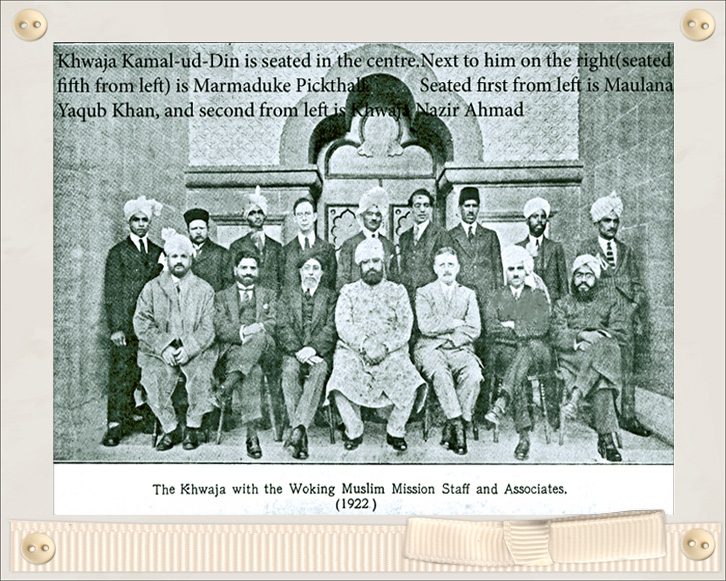
With the departure of Maulvi Mohammad Yakub Khan, who left London on September 20th, en route for India, the Muslim Mission in England loses, for a time only, we hope, a tireless worker, a skilful leader, and a unique personality. The two years of his ministry in this country – brief as the period may seem – have been of outstanding value to the work of the Mission, and have left behind them a mark and, it may also be said, established a tradition which will not easily be effaced or forgotten.
Maulvi Yakub Khan left the Government service at the call of spiritual duty in 1919, resigning a responsible and lucrative position to devote himself heart and soul to the cause of Islam. In 1921 he came to England, where his ripe scholarship and wide experience in affairs were especially welcome. He took over the conduct and management of the Islamic Review, together with the Publication Department of the Mission; and had charge, for a year, of the London Prayer House (111, Campden Hill Road, Notting Hill Gate,W.). During his stay he has translated Sérat-i-Khair-ul-Bashar (The Life of the Holy Prophet), by His Holiness Maulvi Muhammad Ali, and The Secret of Existence, by Khawaja Kamal-ud-din, which is now in the press.
When Khwaja Kamal-ud-Din left England in June for Mecca and his Eastern tour, Maulvi Yakub Khan assumed control of the Mission, and his peculiar fitness for that somewhat delicate post became at once apparent. It is not a position that can easily be filled, neither is the personality of Khawaja Kamal-ud-Din one that can easily be replaced; and personality is, in this connection, a consideration of well-nigh paramount importance. The Head of the Muslim Mission – be he acting or permanent – needs a combination of qualities rarely to be found united in one person; and therefore it may be regarded as providential that there was at hand so fitting a successor upon whom the mantle of Khwaja Kamal-ud-Din might fall.
To the single-mindedness and devotion without which no high cause may hope to prosper, must be added the wisdom of the serpent and the harmlessness of the dove: a mastery of the myriad weapons of theological warfare, and an infinite tact in using them; a wide knowledge of men and affairs; alertness to discern occasion and grasp opportunity, and the ability not only to perceive clearly both sides of a question but also to demonstrate as clearly and convincingly where the other side is wrong; infinite patience, infinite sympathy, infinite understanding. These are the things needful – or some of them – and, looking back on his life and work amongst us during the past two years, to say that Maulvi Yakub Khan possesses all these qualities in a singal degree is to say not a word too much.
A profound thinker, a cogent preacher and an illuminating conversationalist, he based his instruction, not on Reason only, but on reasonableness, which is, to many, a quality at once more appealing and more human; his inflexible principle showed never a taint of bigotry, and his devotion to the Faith was compounded of that wide tolerance and God-begotten charity which are of the very essence of Islam. Argument, from him, bore with double force, because it was untouched by rancour; and his calm and eminently logical personality had a subduing influence on the adversary, which eliminated all bitterness and compelled reflection. He made men think. There is, perhaps, no higher tribute that his fellow-men may render to a servant of the Most High.
Maulvi Yakub Khan possesses, moreover, that rare quality disguised and obscured nowadays by the over-worked phrase “a sense of humour” – the precious gift which is claimed by all men, yet vouchsafed scarcely to one in a thousand; and it is this gift of self-detachment – by virtue of which, had it been so ordained, he might, one feels, have aspired to emulate the achievements of a Dickens or a Gilbert – which enabled him always to take the level view in practical matters and to discharge the delicate duties of his responsible position with unvarying and conspicuous success.
To the little throng of friends and well-wishers that met together at Victoria (S.E. & C.R.) Station on the morning of September 19th, to bid him God-speed, the occasion was a sad one. There were tears in many eyes. As the train steamed out into the sunlight, there was not one of us but felt keenly the sense of loss – the loss of a friend, of one who was carrying with him to his well-earned rest the respect, the confidence, the love, not of us only, his fellow-workers, but of all who know him. May he soon return to us.
(Courtesy: aaiil.org)