Id-al-Fitr at the Mosque Woking (April 24,1959)
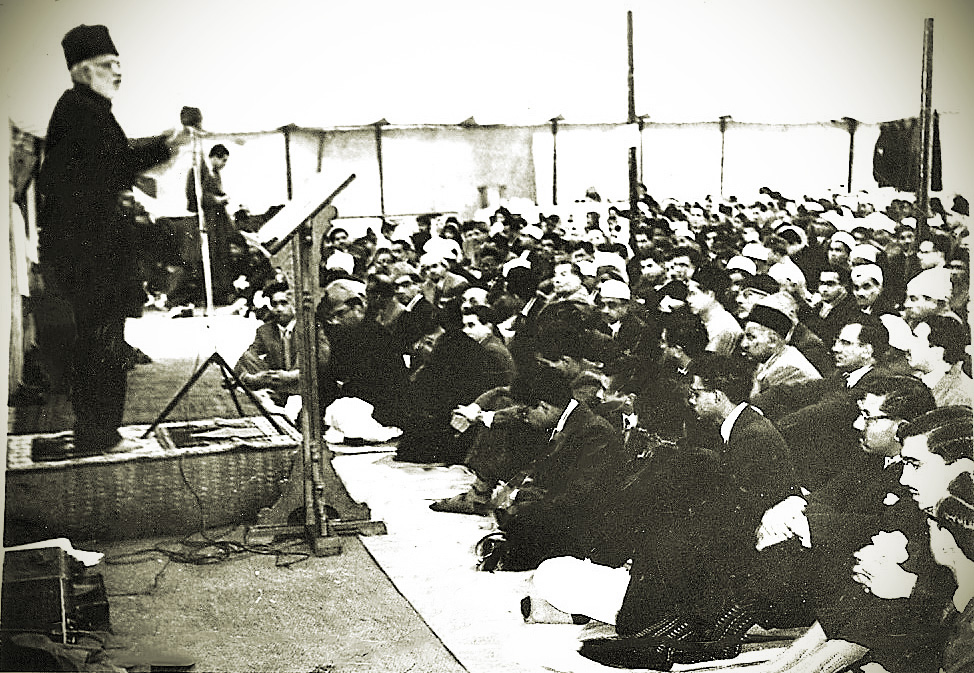
The Imam, Maulana Muhammad Yakub Khan, exhorted the Western People to bring a more objective view upon the Teachings of Islam
Silver Jubilee of Woking Muslim Mission to be celebrated in 1962
Leading Papers of England and Cairo carried its reports
The Id-ul-Fitr was celebrated at the Mosque, Woking on Friday April 10, 1959. The Cypriot Turkish Muslims had celebrated the Id at the same place, a day earlier, following the example of Turkey where the celebration took place on Thursday. Still the huge marquee was found too small to accommodate the congregation, and the back screens had to be pulled down to let the overflow outside in the open join up with the main body.The woman had one wing reserved for them on the left side. The right wing was reserved for visitors, and members of the Press.
April is a bad month from the point of weather and April showers are something like the summer showers of Pakistan which may come any time, and after a brief downpour disappear. Nevertheless, April 10 was just the one brief day that was spared this ordeal and the celebration went on undisturbed.
In pin-drop silence, the Imam, Maulana Muhammad Yakub Khan delivered his half-an-hour long Khutba (Sermon). He exhorted the Western people to bring a more objective view upon the teachings of Islam. In so many spheres of life, he reminded them, they were already practising Islam. In the more burning issues also they would find light in Islam.
After the prayer and khutba, a German lady came up to the platform and asked to be admitted to Islam. There was much enthusiasm when the lady recited, after the Imam’s recital, the Kalima-i-Shahadat in Arabic followed by its translation in English. She adopted the Islamic name Ameena. Then began the usual greetings, embracing each other.
The congregation of about 2500 was representative of all Muslim Countries, the Marquee, as usual, fluttered the flags of all Muslim Countries, as well as of countries with substantial Muslim populations.The usual lunch of rice and curry was served on the self-help system, under the management of Major Farooq Farmer assisted by about two dozen volunteers’ ladies as well gents. Lunch was followed by tea to which everybody helped themselves. Friday Prayer was said in the Mosque, where accommodation had to be provided by laying prayer rugs outside as well.
Begum Abdullah, Messrs. Yahya Butt, Iqbal Ahmad, Muhammad Hassan Shah, Yusuf, Khalid and Farooq spared no pains to lend a hand in looking to the various arrangements. Among those who attended were the High Commissioners for Pakistan and Malaya and Begum Ikram Ullah, and many members of the diplomatic Missions from Muslim Countries with their wives and children.
A very important suggestion was made by a Pakistani leader, once the Secretary of the Muslim League in the Punjab that in view of the historic role, the Woking Muslim Mission had played as the torch bearer of Islam to the West and in the revival of Islam among Muslims; preparations should be forthwith taken in hand to celebrate its Silver Jubilee in 1962, when it will be 50 years old. The workers of the Mission, it is hoped, will before long, draw up a plan to implement the suggestion in befitting manner. One shape it is likely to take will be the compilation and publication of the whole story of the building of this Mosque by Gottlieb Wilhelm Leitner in 1889 and the founding of the Mission by Al-Haj Khwaja Kamaluddin in 1912, the various Imams and workers that came from time to time, the prominent English men and women who embraced Islam, the literature produced and the reorientation brought about in the people’s outlook on Islam.
A couple of days before the Festival the B.B.C. T.V. Home service gave a brief account of the Shah Jehan Mosque, Woking, why it was so named and its brief history. The Times of London (April11, 1959) treated the Id celebration as one of few high lights of this country’s life which this paper displays in the pictures on its back page. Its picture of Id Celebration at Woking covers only a corner of the congregation giving a glimpse of the ladies who participated in the Prayers.
(The Light – 24 April 1959)