Frontier Minister’s Nation-Building Measure
Perhaps no communalism is more dangerous for the growth of a united nation than communalism in language. What exactly we mean by this sort of communalism is illustrated by the Hindi-Urdu tug-of-war that has been going on for years past. With the dawn of national awakening among the Hindu intelligentsia, came the realization of the importance of national culture as a nation-building force. And since to the Hindu nation-builder, unfortunately, nation has somehow meant the Hindu-nation, national culture has been identified with the revival of Hindu culture. The overthrow of Urdu which had Islamic associations, being the product of the impact of Islam and Hinduism during the Moghul rule, therefore, formed one plank of the Hindu nationalists programme of national reconstruction, regardless of the -consideration that it already occupied the position of a lingua franca and was understood throughout India. So started the campaign to install Hindi script instead of Persian, so far in vogue and Hindi, instead of Urdu. What is the net result? The people are being gradually divided into two water-tight compartments. A Musalman, who picks up a daily Hindi paper which reflects the day-to day life of the Hindus, finds it quite a sealed book. Even the Hindu papers in Urdu script that still linger – for the average Hindu has not been able to dispense with Urdu script – is almost unintelligible to a Musalman, being profusely be-sprinkled with Sanskrit or Hindi words. The result can very well be imagined. The door of mutual understanding, so to say, is being closed. The Hindus and Muslims, rather than march along the same road towards a common national destiny, are following two distinct roads of development, accentuating with every step onward differences and dissensions between the two. This is the danger ahead, a danger to the entire future of India. Asa result of the substitution of Hindi for Urdu, two potential enemy nations are day by day growing within the same country, the same town, the same village.
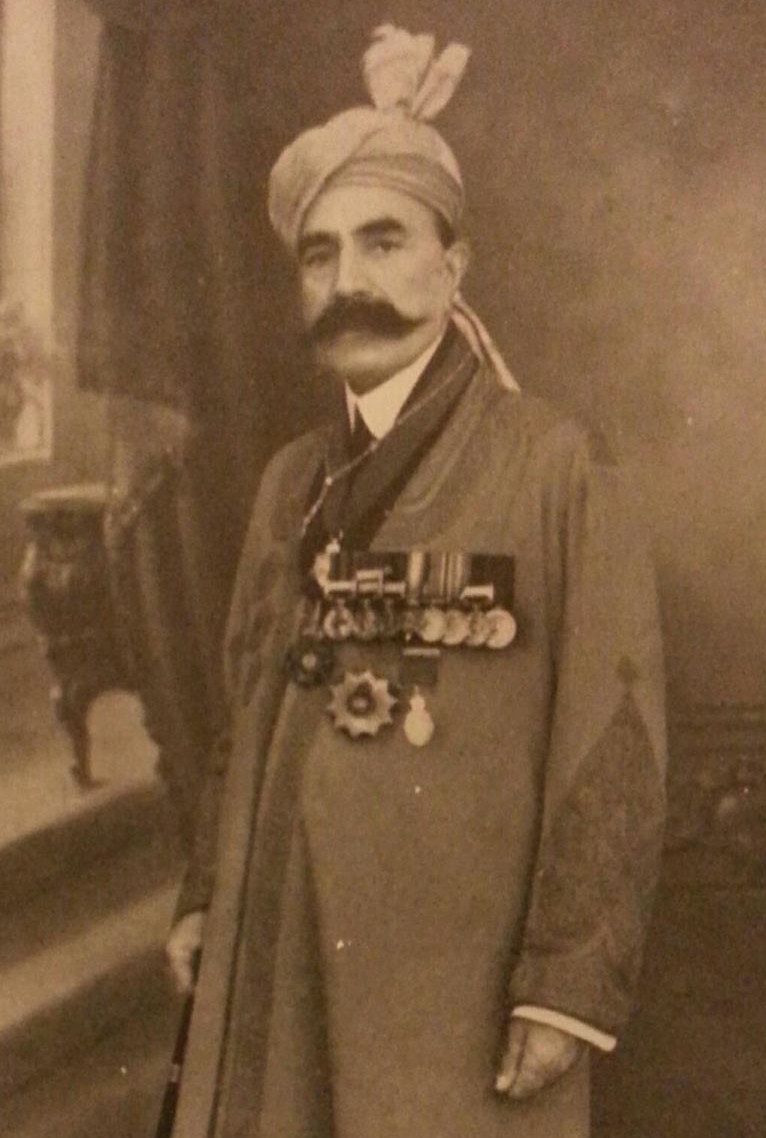
Nawab Sir Abdul Qayyum khan
The Hon’ble Nawab Sir Abdul Qayyum khan, Education Minister, has grappled with this great national danger in the only way compatible with the ideal of a united Indian nationhood. He has ruled that in a Province, where 95 percent of the population is Muslim, Pushto, Hindi or Gurmukhi shall not be the medium of instruction beyond the first two years in the elementary school. ”Since the object of education ”, he rightly observes, ” is to impart instruction on the broadest possible basis and to render the pupil fit to take his (or her) position as a citizen of the Indian Empire, education in water-tight compartments is to be avoided.” He has further laid down that schools now using Hindi or Gurmukhi or Pushto or any other language as a medium of instruction must change it to one common medium, Urdu, if they want to continue receiving grant-in-aid.
Whereas the future historian will no doubt credit the Minister with having laid the foundation-stone of a united nation, the Hindu communalists have, as usual, raised a hue and cry, characterising this measure as ”something extremely detrimental to their religious and cultural interests”. They close their eyes against the fact that Pushto, the language of the 95 per cent majority has equally been precluded from being a medium of instruction. They have even started a ” Hindi; Gurmukhi Defence Committee ” at Peshawar to fight this change. We may only say that this mentality cannot be too much deplored. The change proposed in no way threatens the ” cultural interests ” of the Hindus or Sikhs. They will be perfectly free to teach Hindi and Gurmukhi in their schools, without losing a pice of their grant-in-aid. This leaves them ample latitude for inculcating their exclusive cultural traits among their rising generations. What the change wants is that Hindi or Gurmukhi must not be the medium of education; for that would obviously amount to “something detrimental” to the larger interests of India, at least Upper India, with which the lot of the Frontier is so closely connected. It must not be forgotten that Frontier Hindus, especially those in the villages, are already half Pathans. Besides Hindi, they speak Pushto, the language of the Pathans, as fluently as the Pathans. Their relations with the majority community have always been such as should serve a model for the rest of India. A solitary Hindu resident in a Pathan village lives in perfect harmony with the Pathans, carrying on, without let or hindrance, his retail business as well as moneylending. In fact the Pathans consider it a point of honour to see that he is in no way molested, and have often defended the Hindus with their lives against armed attacks by the trans-border or local dacoits. Communalistic tension has been practically unknown in the Frontier and whatever of it one finds today is of foreign importation. It is against the genius and the traditions of the Pathans. The outside wirepullers who try to fan the flames of communalism will do well to leave that Province alone. The best interests of the 5 per cent Hindus and Sikhs in that Province require that their present harmonious relations with the majority community should in no way be disturbed, that in fact they should be still more closely knitted to the majority. The Minister’s’ circular, while leaving them more than ample sphere, for the development of their religious culture – for they are at liberty to teach, Hindi and Gurmukhi as two subjects – only safeguards against the danger of driving a permanent wedge between the majority and the minority’ communities which the difference in the medium of instruction certainly amounts to. Whatever the present hue and cry, we are sure, the coming generations of Frontier Hindus will bless the Nawab Sahib for refusing to be swayed by the pious communalistic indignation of narrow visioned agitators and saving them from the catastrophe of a permanent split with a people with whom, more than with the rest of India, their future, for good or evil, is inseparably inter-linked.
By
M.Y. Khan B.A. B.T.
(Friday, November 8, 1935 – The Light)