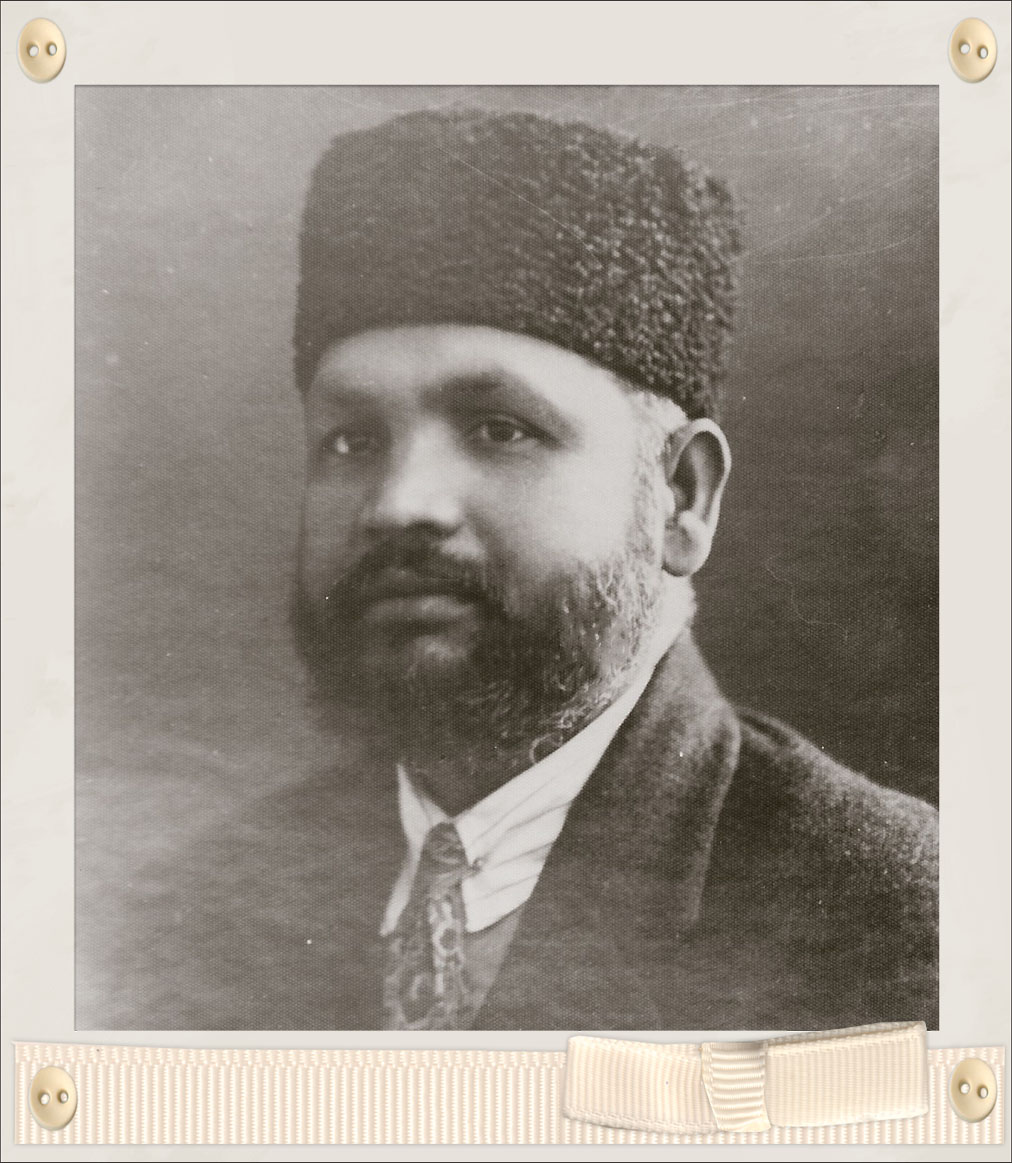
MEET THE MESSENGER OF GOD (Part 3)

Al-Amin: The Embodiment of Uprightness
By MUHAMMAD YAKUB KHAN
While yet in the prime of life, the Prophet Muhammad’sﷺ name was a household word for the highest standard of integrity and uprightness. For these qualities, as we saw in our last article, he was acclaimed by friend and foe as Al-Amin (The Trustworthy).
In the most crucial moments of his eventful life the Prophet ﷺ lived up to this reputation. Indeed, the more critical the situation Divine wisdom placed him in, the greater the lustre it brought to bear upon this dominant trait of his personality. Let us recall two more such highlights of his life.It was the thirteenth year of the Call. The Meccans’ persecutions of the small band of Muslims had touched the peak point. Life had been made intolerable for them. The Prophet had permitted them to seek shelter wherever they could find it. Some time ago, batches of Muslim refugees had migrated to Ethiopia, where they received asylum from the Christian king of that country. Now, when things once more became too hot for them, the Prophet advised his comrades to go to Medina and settle down there. While everybody was gone, the Prophet, like a dutiful leader who cares more for the safety of his people than his own, stayed behind. He was awaiting Divine revelation to show him the green light to go ahead with his emigration plan. Along with him stayed behind just two men, Abu Bakr and Ali, his closest associates. They pressed him again and again to quit Mecca which had become unsafe for his very life. But no! The Prophet ﷺ would not take one step without making sure that it was God’s will to do so.On the other side, activities in the enemy camp had reached boiling point. Alarmed at the rapid growth of the Muslims’ strength at Medina, the Meccans held a general council to consider how to meet the danger. Leading men from among each clan participated in the deliberations. Various ways and means were suggested as to how to extirpate Islam. One suggestion was to imprison the Prophet. Another thought banishment would be the best way to deal with him. Abu Jahl, the ringleader, did not find these to his satisfaction. So long as the Prophet was alive, even though in captivity or exile, he was bound to be a force. Abu Jahl would not advise taking risks. He did not believe in half-measures. He thought the Prophet must be done away with. That was to him the only way to get rid of the threat of Islam once and for all.
To kill the Prophet, however, was no easy job. It meant stirring a whole blood feud with his clan, the Banu Hashim, who, though equally opposed to his mission, were honour-bound by the code of Arab chivalry to avenge the blood of their kinsman. It was therefore beyond the power of one individual to touch the Prophet. The entire clan of Banu Hashim would be up in arms against him. To tide over this difficulty Abu Jahl hit upon a plan. Let each clan contribute one man towards the foul deed, he suggested. The gang thus formed should in a body fall upon the Prophet and finish him. This would obviate the risk of individual action. The Banu Hashim would not be a match for all the clans combined.The horrible plan being agreed upon, a body of armed men was forthwith got up, which laid siege to the Prophet’s house to attack him in a body as soon as he came out. The Prophet also came to know about this. When things reached this stage, Divine revelation also came to advise the Prophet that it was time for him to migrate also. While, however, he was making secret preparations how best to slip out of the murderous trap that was laid for him, the one thought that was uppermost in his mind at this moment when his very life was hanging in the balance was what to do with the deposits which various men had entrusted him with for safe custody.
Be it noted that while every Meccan was out for his blood and considered the Prophet his chief enemy, he was yet the one man, out of all the people. considered trustworthy to keep deposits with. At that very moment when he had to flee for his life, he had a number of deposits in his custody. What to do with those deposits? This was the question that meant more to him than his life. He could not possibly leave without returning all these to the owners.At last he thought of a solution. He sent for Ali and apprised him of the whole situation. Divine permission to quit had come, he explained, and he wanted to go. But there were two obstacles in the way. First. there was the enemy gang on the lookout for him, and second there were the safe-deposits of the people with him which had to be returned. To get over both these obstacles he sought Ali’s help. Ali was to lie down in his bed. This would put the besiegers off their guard, thinking their prey was secure in their hands. This would also take the other load off his mind. First thing in the morning, when Ali rose, he was to call on every depositor and return his deposit to him intact.What a code of honour! There he is in the very jaws of death. His bloodthirsty enemies are at his doorstep. With drawn swards, they are impatiently awaiting the moment when he should emerge out of his house to strike at him, it is but human should he in this supreme moment forget everything else except his own safety. The Prophet was, however made of sterner stuff. With him honour was more than life.It was unthinkable for him to slip quietly away; that would mean betraying the confidence reposed in him by the people. What did it matter, if death stared him in the face? It was easier to face death than run the risk of what might be construed as bad faith. What weighs on his mind is the question of the people’s deposits. He cannot think of leaving without making sure that these would be duly returned. The Al-Amin proved Al-Amin even in this fateful hour when the enemy’s sword was hanging over his head!
We get a glimpse of the Prophet ﷺ as Al-Amin when the scene was shifted from Mecca to Medina, where he, along with his handful of followers, settled down. The Hijra opened a new chapter in the fortunes of Islam. The small Muslim fraternity daily gained in strength by the addition of more and more converts. The rapidly growing power of Islam filled the Meccans with apprehension. They made repeated attacks on Medina to nip the growing menace in the bud. Every time, however, they suffered reverses at the hands of the Muslims. Even their last combined attack, known as the Ahzab, ended in a miserable rout. Thinking that the Meccans’ anti-Islamic fury had spent itself, the Prophet thought of performing the pilgrimage to the House of the Kata. This was a privilege which from times immemorial was not denied even to the worst of enemies. Indeed, all warfare was taboo during the months of the pilgrimage. There could be no reason, thought the Prophet, why the Meccans should obstruct him in the performance of this religious duty.
Al Hudaibiya
So along with 1,400 of his followers he set out on the pilgrimage to Mecca. To disarm all possible misgivings as to his peaceful intentions he saw to it that the Muslims carried no arms except swords, which were to be kept sheathed. The Prophet’s hopes were, however, soon belied. When the Muslim caravan reached the vicinity of Mecca, news was brought that the Meccans with their allies had mustered strong forces to offer opposition. A messenger was forthwith sent to explain that they had no hostile intentions, that they were there to perform the Hajj. As a further guarantee of their peaceful intentions, an offer was made to the Meccans to conclude a truce for a number of years. The Quraysh elders welcomed the offer. They had by now grown wise enough to realize that they could not crush Islam by force. They deputed one of their wisest men, Urwa by name to negotiate terms with the Muslims. The Muslims were encamped at Hudaibiya, a place at a day’s journey from Mecca. Urwa came to the Muslim camp to discuss terms with the Prophet. The negotiations failed, on which the Prophet deputed another leading Muslim to go to Mecca and bring round the Quraysh to agree to the truce terms. The envoy was, however, ill-treated. His camel was killed. Besides, a detachment of the Meccans fell upon the Muslims by surprise but was itself taken prisoner. To promote his peace mission, however, the Prophet, rather than punish this act of treachery, set the whole party free. And to push forward his truce plan, he deputed a man of the high social standing of Uthman, who had considerable influence at Mecca, as his envoy to discuss terms with the Quraysh. Uthman also was not properly treated. He was kept under a strict watch which led to the rumour that he had been killed. When the rumour reached the Prophet, he realized that the Meccans were bent on mischief. He had no alternative left except to strike a blow in self-defence in case the worst came to the worst.
Death-pledge
It was a most critical situation. The Prophet’s following was but a handful of men with no better equipment than swords. His unbounded faith in the righteousness of his cause, however, made up for the lack of numbers and arms. He called upon his men to take a fresh oath of allegiance that in the event of a Meccan attack, they would stand by him till the last man, and the last drop of blood. This allegiance goes down in the history of Islam by the name of Bay’t-i-Ridwan. When the news of the Muslims’ desperate resolve to fight to the bitter end reached the Meccans it put them in a chastened mood. To obviate another disaster, they considered discretion the better part of valour, and sent one. Suhail by name, with truce terms of their own. Suhail’s terms amounted to treating the Muslims as a defeated party. Among others, one term was especially distasteful to the Muslims. If any of the Meccans should abscond and join the Muslim camp at Medina, it laid down, he was to be repatriated to them, but if any of the Muslims should desert Islam and make common cause with the Meccans, the latter were not bound to hand him over to the Muslims.This term placed the Muslims at a great disadvantage. But the Prophet was anxious to maintain peace at any cost and wanted to accept even conditions so humiliating. This caused a great deal of dissatisfaction among the Companions. The Prophet, however, sacrificed the sentiments of his associates to the cause of peace so dear to his heart. And the treaty known as the Truce of Hudaibiya, with all the disability it imposed on Islam, was put in black and white.
Truce put to the test
The ink of the treaty had hardly dried when it was put to the most acid test ever recorded, in the annals of international code. It so happened that one Abu Jandal, who had recently joined Islam was caught by the Meccans. Day after day he was mercilessly beaten by them to make him recant the faith but to no avail. Every refusal on his part was followed by worse torture. Hearing that the Prophet was encamped at Hudaibiya, Abu Jandal was on the lookout for an opportunity to make good his escape. Once he was in the camp of Islam, he thought, he would be safe. Finding his opportunity one day, he gave the slip to his captors and made a desperate dash for Hudaibiya. After a tiresome run along unfrequented routes he at last reached the Muslim camp. The Meccans, however, demanded his repatriation under the terms of the treaty that had only just been signed. This was a most difficult situation. There stood Abu Jandal, the very picture of misery, tortured for accepting Islam, pleading with his fellow Muslims for asylum. There were the Meccan delegates demanding that the treaty must be honoured, and the fugitive handed over to them. Abu Jandal uncovered his bleeding back to let the Muslims see the hell of torture he had been going through. This sent a shudder through the Muslim fraternity. They all pleaded with the Prophet to intervene and turn down the Meccans’ demand. For the Prophet himself, who was mercy personified even for his foes, it was a most excruciating moment. But an agreement, once signed, was something sacrosanct for a Muslim. It could not be just thrown away as a scrap of paper. Islam lays the greatest possible stress on the honest fulfilment of all agreements. The Prophet was faced with a most difficult choice. Apart from the fact that Abu Jandal had been tortured for the faith of Islam, on mere humanitarian grounds he was a very strong case for being given asylum. There was the strong current of the Muslim gathering’s feelings on the question.In the midst of this internal conflict that the Prophet went through, however, there came ringing the clarion call of the Qur’an, Aufoo bil ugood (Make good what you pledge!). The Prophet’s choice was made. The treaty must prevail. Abu Jandal must go back with his persecutors. And in the midst of scenes of the deepest pathos, he was allowed to be snatched away, so that the high standard of integrity Islam demands in all relationships was not lowered.
Honours treaty obligations
Soon after the Prophet arrived back in Medina there came up another similar case. Another convert to Islam, ’Utba by name, tortured no less mercilessly by the Quraysh, followed the example of Abu Jandal and reached Medina. Two of the Quraysh followed close upon his heels and demanded his repatriation under the provisions of the Treaty of Hudaibiyah. Like Abu Jandal he was also told to go back with the Meccans. ” Do you force me back to idolworship?” remonstrated `Utba. A trying situation for the Prophet again, ’Utba pleading for asylum in the name of religion, and the Quraysh insisting on their pound of flesh!! But word once pledged must be honoured whatever the cost. ” `Utba,” said the Prophet, ” we cannot but hand you back to the Meccans. It may be that God may provide another way out for you.” ’Utba, like a true Muslim, bowed before the Prophet’s decree. And a way out was now providentially thrown open before him.
On his way to Mecca, in the custody of the two Meccans, it struck him to make a bid for freedom on his own. At the first opportunity, finding the men off their guard, he struck one down, and the other took to his heels. ’Utba was now a free man. But the door of Medina was still blocked to him by the treaty. Consequently, he selected a neutral zone, a place called ’Is, on the coast, falling neither under the jurisdiction of the Quraysh nor of the Muslims, and took up his abode there. As the news reached Mecca, other persecuted Muslims also flocked there, so that it soon grew up into a Muslim settlement free from the inhibitions of the Treaty of Hudaibiyah. This new stronghold of Muslims became a new threat to the Meccans’ trade with Syria. The only way to liquidate this centre was to open the gates of Medina to converts to Islam. So, they came to the Prophet, offering to abrogate the treaty terms banning entry into Medina of new converts, to which the Prophet readily agreed.
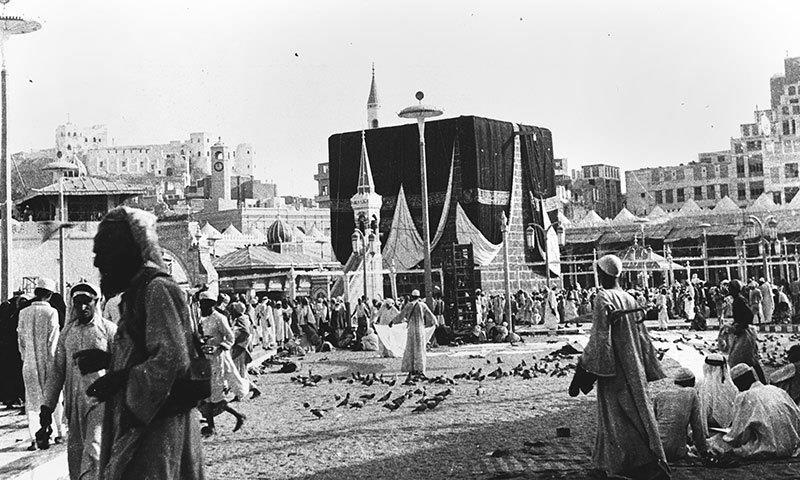
A view of the sacred Ka’baa where the Prophet Muhammadﷺ, along with 1400 companions, wanted to go for pilgrimage, but was not allowed to do so by the Quraysh. He then had to negotiate a truce treaty at Hudaibiya, a place about a day’s journey front Mecca.
(The Islamic Review – April 1959)