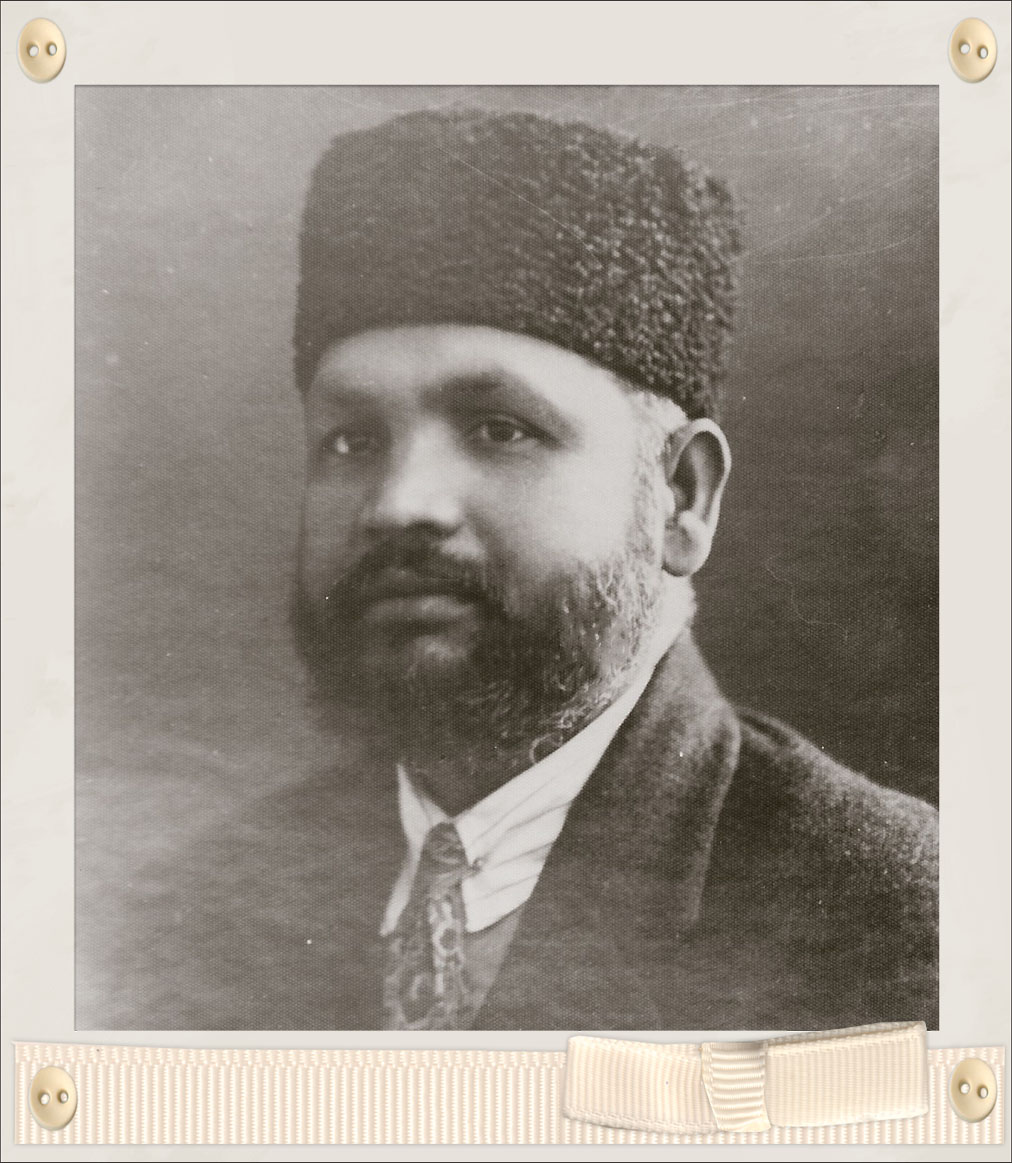
KHUSHAL KHAN KHATTAK
FATHER OF PASHTO RENAISSANCE
Whether Khushal Khan was a better poet or warrior is difficult to decide. He wielded both his pen and sword with a force as if he was a born poet and a born warrior.
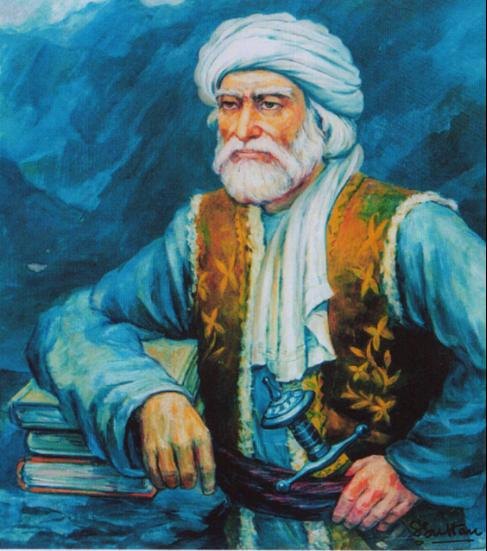
Midway between Attock and Nowshehra railway stations on NWR, as the train pulls up at a way-side station, the passenger´s eye meets the signboard, Akora Khattak, designating this station after an unassuming village of that name close by leading a quite humdrum life. Little does he dream that with that name is wrapped up a most thrilling story of Pathan history and that three hundred years ago in this strip of arid territory with a range of bleak hillocks extending towards the south and the Kabul (Landai) river to the north arose a unique leader of men who wielded the sword and the pen with equal ease, who gave the grand Mughal Emperor Aurangzeb many a sleepless night and who, for his literary activities came to be known as the father of Pashto language. This was Khushal Khan Khattak whose great-grandfather Malik Akora founded this village,migrating from the original home of his tribe at Karbogha in the Tehri Tehsil of Kohat District.
Malik Akora, who was a soldier of fortune and lived on the exploits of his sword, soon attracted the attention of Emperor Akbar for his bravery and daring who appointed him Mansabdar, charging him with the custody of the highway, and in return, conferring on him as “Jagir”, the territory between Khairabad (a village on the Indus across Attock bridge) to Nowshera. The distinction passed down to his son, Yahya Khan and grandson Shahbaz Khan both of whom served the Mughal Durbar with all loyalty and devotion. On the death of his father, Shahbaz Khan, our hero, Khushal Khan appears on the scene both as the chieftain of his clan and as Mansabdar under the Mughal throne now occupied by Shah Jehan. Brought up in traditions of loyalty, Khushal left no stones unturned to win the favour of his master, and ruthlessly put to the sword his own people for the slightest uprising anywhere in the frontier against imperial authority. His military exploits in the service of the grand Mughal carried him to far-off theatres of hostilities – Balkh and Badakhshan on one side and to Kangra on the other where he, with a handful of his men captured the fort of Taragarh which the imperial forces had failed to subjugate. With coming of Aurangzeb to the Delhi throne, however, came the turning point in his fortune which, from a devoted loyalist, transformed him into a determined foe of the Mughal rule and the founder of Pathans´ independence struggle.
This is how it happened. On ascending the throne, putting his father into prison and otherwise liquidating his brother, Aurangzeb started a purge of pro-Shah Jahan elements and since Khushal khan was reputed to be a favourite of the imprisoned monarch, he was also marked out as “dangerous”. Under instructions from Delhi, the Governor of Peshawar invited him for a friendly talk but when Khushal Khan went to see the Governor he was quietly arrested and sent to Delhi where he was kept as a state prisoner for a year, subsequently transferred to a hill fort, Ranthampur, near Chitor where he was detained for another year and a half. This made him bitter. This is how he describes the event:
(Pashto poetry translation)
“I thought in the Mughal´s service I would make stirrups of gold and silver shoes for my horse. For nothing, however, chains were put on my feet. What an appreciation and what a reward”.
While in prison Khushal Khan tells us in one of his poems, he was well treated and was supplied even with such indoor games as chess and “nard”. He was given every facility to correspond with and have as many interviews with his relations as he liked. In fact, some of his most touching poems, depicting Aurangzeb´s “tyrannies” were composed in jail which shows he was freely supplied with books and writing material.
In the meantime, the state of things in the Frontier grew from bad to worse. Emperor Aurangzeb sent for Khushal Khan to seek his advice. Khushal Khan suggested the appointment of Mahabat Khan as Governor at Peshawar which the Emperor accepted. The new Governor requested the Emperor to allow Khushal Khan to accompany him to control the situation. Thus, came about the release and return of Khushal Khan to his homeland. But he came back a changed man. A Pathan never forgets. Khushal Khan could never reconcile himself to slavery of Mughal rule and henceforth he became the leader of the Pathans´ liberation struggle. When approached by Mahabat Khan and others to help in crushing certain Pathan tribes which had risen in revolt, Khushal Khan refused point-blank to raise his hand against his own people. This is how he describes his changed mind:
(Pashto poetry translation)
“When I have become a Pathan with this white beard. I am not going to become a Mughal again. Now I will talk to Mughal as man to man. May my head fall if it ever again bowed to him.”
The rest is a story of a stubborn resistance movement against Mughal forces which Khushal launched single-handed going from place to place and rousing the tribes against alien domination. In the skirmishes and pitched battles that ensued the imperial forces were badly mangled and routed. This created a commotion in Delhi and Aurangzeb had in person to proceed to the “front”, setting up his headquarters at Hasan Abdal. A more tactful Governor was appointed at Peshawar to meet the situation which was fast slipping out of hands. The new man well acquainted with Pathan´s weaknesses considered diplomacy a more effective weapon to crush Khushal Khan than a straight fight. He bought his son Bahram Khan and set him against his father. In the engagements that took place between the father and the son, the old man always had the upper hand. An unusual Pathan who remained invincible on the battlefield fell victims to the “silver bullets”. Broken-hearted Khushal Khan betook himself to the land of the Afridis where at a place Dambara death rang down the curtain on this dramatic eventful life. This is how Khushal Khan gives vent to his feelings at his betrayal by his own people:
(Pashto poetry translation)
“On account of Pathans betrayal I will go to my grave broken-hearted.”
This is how he goes onto lament the failure of his struggle:
“The Pathan is in every way superior to the Mughal, but alas, he lacks unity. If ever the Pathans are blessed with unity, it will restore old Khushal to youth”
Khushal Khan attributes the failure of his mission exclusively to disunity among the Pathans. Like a wounded lion, licking his wounds, this is how he roars:
(Pashto poetry translation)
“Pathan has remained a stranger to unity,
Else I would have torn the Mughal´s shirt to shreds.”
Whether Khushal Khan was a better poet or warrior is difficult to decide. He wielded both his pen and sword with a force as if he was a born poet and a born warrior. Beside this rare combination what makes his personality unique is that he was a profound thinker and his Muse at times throws flashes into the regions of such meta-physical problems as the human ego and destiny. He was fully conscious of his gifts and recorded his own estimate of himself:
(Pashto poetry translation)
“Never again will come another patriot like me,
Never again will come another warrior like me,
To say nothing of Khataks, among all Afghans
Hardly will such a man of wisdom ever come.”
What a ring of Iqbal´s line:
Khushal Khan´s heart overawed with the love of his country and people. While a State prisoner in the fort Ranthampur his heart pined for his native village. Akora-Saraj, its rivers and hills. Addressing the usual Baad-e-Nasim, the poet beseeches it to waft his salam to Aba-Sind (Indus) and Landai (Kabul river) and addressing the two beloved rivers of is homeland he gives vent to the longing:
(Pashto poetry translation)
“May be that once more I may be privileged to have a glass of your water. How long shall I be on the Ganges and Jumna.”
Mark the intense patriotism of the following:
(Pashto poetry translation)
“The flowers of other lands cannot equal the thorns of one´s own homeland nor the sugar of the former can equal the ´gurgura´ (a wild cherry) of the latter. The crow at one´s own homeland is better than the falcon of another land”
As to motherland, the poet invests it with the deepest sanctity:
(Pashto poetry translation)
“Where fall footsteps my mother,
That land is the garden Eden for me.
Would that my body were the dust of the path,
Along which passes she,
There is nothing like one´s own mother
All else is vain talk,
Would that I had wings,
to reach Sarai but once.”
Khushal Khan had a burning passion for the honour and glory of his people. When one of his sons died in the full bloom of youth (26) this is how he bewailed his death:
(Pashto poetry translation)
“Would that in this youth he had died for the glory of Pathans,
Instead of leaving for the grave from the bed,
The son who dies for the nation´s honour,
He makes his father´s neck erect among people.”
Khushal Khan commanded a force of expression which should win him a place among the world´s foremost poets. Mark the sting of the satire against Aurangzeb:
(Pashto poetry translation)
“The knife with which he mends his pen to write the Quran with –
With the same knife he cuts the jugular vein of his brother,
In ´ruku´ he prays for father´s death,
In ´sujood´ he curses his elder sister.”
Khushal Khan was a most versatile genius as a poet writer and there is hardly any topic from the mysteries of Tasawwaf, the niceties of Islamic jurisprudence to “Shikar” his pet hobby which he has not touched.
Of Mullas prayers he says:
(Pashto poetry translation)
“These Mullas who say prayers and keep fasts want paradise,
Khushal knows no such wage-earning worship.”
Among his many works besides his well-known voluminous Diwan are ´Hidaya´ and ´Aeena (translations from Arabic books of Fiqah. ´Sihat-ul-Badar (about health and medicine) and ´Baz Namu´(dealing with Shikar). He started versification at the age of 18 and continued it to the end of his life. He is justly acclaimed as the Father of Pushto. Of his services to Pushto he says:
(Pashto poetry translation)
“In poetry, in prose, as in script
Pashto language is much beholden to me
Before this it had neither a book nor script
Lo! I have compiled in it good many books.”
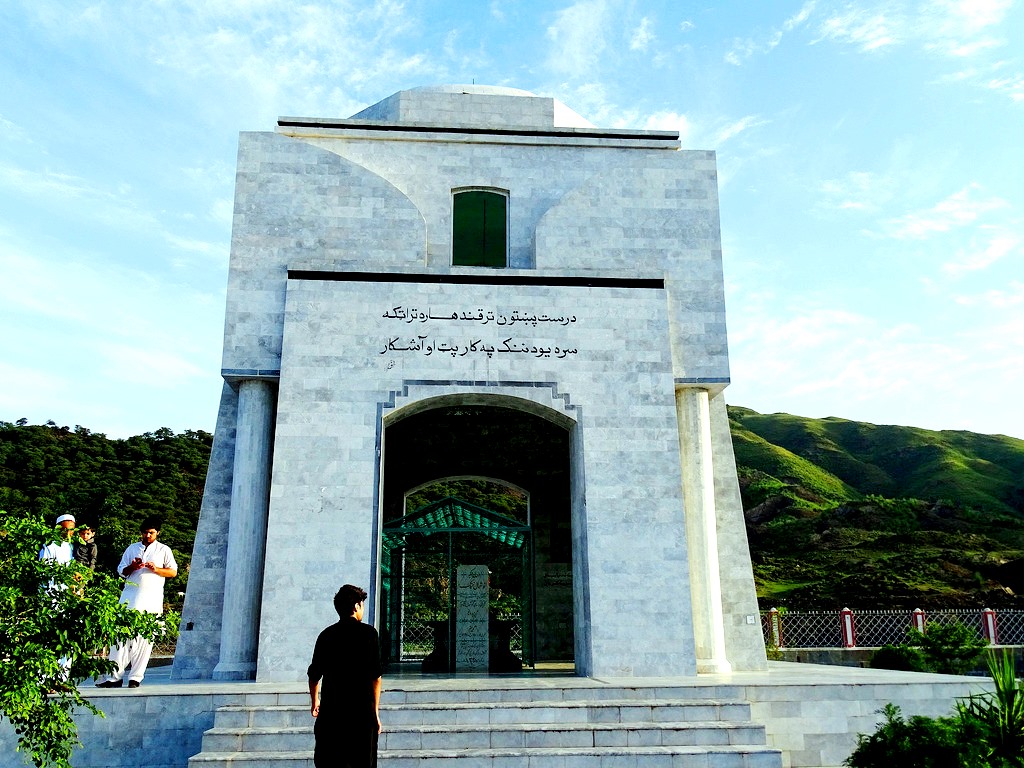 Born in june 1613. Khushal Khan died in Ferbruary 1689 at the good old age of 76, having lived a rich and full life as father of 60 sons and 31 daughters. Before his death he made a will that he should be buried where even the dust of Mughal soldiers´ horses should not disturb him. Accordingly, his body was interred at an out-of-the-way place, Asuri Bala, about 6 miles from his birthplace, Sarai-Akora. Iqbal in one of his poems entitled “Khushal Khan Khatak” thus eulogises the Khan´s spirit of independence:
(Urdu poetry translation)
”Let the tribes merge in the millat´s unity so that the Afghans name may be exalted. I love the young men who aim at capturing stars. This child of the hills is in no way inferior to the Mughal.
O friend, shall I tell you the kind of grave Khushal Khan likes – the one where the mountain breeze cannot bring even the dust of the Mughal horsemen´s steeds.”
Three centuries which have since elapsed have failed bedim the splendour of this most colourful figure that walked erect with all the pride and dash of his race on the stage of Pathan polities and challenged in the name of his people the might of the grand Mughal. Khushal Khan Khattak may without exaggeration be described as the riche’s heritage of Pathan history and culture. Obscured so far from full view by the exigencies of an alien domination, Mr. Dost Muhammad Khan Kamil, M.A., LL.B, has atoned for this national sin by rescuing this legacy from the limbo of oblivion and re-blazing the trail of this most romantic and thrilling life-glory in the form of a book, “Khushal Khan Khatak” (Dar-ul-Ishaat Sarhad, Peshawar)
It is a happy idea that he should have chosen Urdu for giving a portrait of this Pathan prodigy in both the realms of the pen and the sword to introduce Pathan culture to a wider circle of readers. The author has bestowed much labour of love on the work which should serve as a stimulus to others to follow up the quest and restore this national hero of Pathans to his rightful place.
By Mohammad Yakub Khan

.Editor: The Civil & Military Gazette Lahore,Pakistan
Gazette Sunday Digest – December 14, 1952.