CONSTITUTION MAKING – Part 4
Opposition and its role
وَتَعَاوَنُوا۟ عَلَى ٱلْبِرِّ وَٱلتَّقْوَىٰ وَلَا تَعَاوَنُوا۟ عَلَى ٱلْإِثْمِ وَٱلْعُدْوَٰنِ
Al-Ma`idah 5:2 (The Table Spread)
The existence of a responsible Opposition Party is the very breath of Democracy as well as of the Islamic way. Free expression of opinion and criticism of the highest authority was the hallmark of the Islamic way. Islamic history records instances which to this day, shine as the brightest examples of true democracy and human rights—the Caliphs themselves being publicly called to account and even brought to the Qadi’s court to answer charges. Rather than evoke resentment and victimization, the Caliphs applauded the spirit of free criticism as a symptom of the vitality of Islam.
The Islamic conception of Opposition, however, differs from the Western in one vital feature: it is not opposition for its own sake, with a view to capturing power by ousting the Government in power. On the contrary, Islamic Opposition is enjoined to cooperate with the Government in everything good and right and to withhold cooperation only when the Government goes wrong. The first Caliph’s one-sentence declaration on the assumption of office sums up a whole volume of healthy statecraft:
فَإِنْ أَحْسَنْتُ فَأَعِينُونِي وَإِنْ أَسَأْتُ فَقَوِّمُونِي
“If I do what is good, lend me your support; if I go wrong, put me right.” (Hazrat Abu Bakr)
History has yet to produce a higher and healthier pattern of relationship between the Government and the people. There were few organised political parties then. But the public as a whole was vested with tilt; right to oppose the Head of the State himself. The motive of the opposition: however, is all-important: it must be to put right – not to oust the Government in power, as in vogue in the West. Change of Government should be left to the verdict of the electorate; it should never be the motive of the Opposition.
Anyway, on the basic right of the individual to criticize the Government, Islam is very emphatic. It not only treats it as the individual’s right but his duty. A saying of the Prophetﷺ describes this kind of criticism as the highest Jehad:
كَلِمَةُ حَقٍّ عِنْدَ سُلْطَانٍ جَائِرٍ
(The Book of al-Bayah Chapter 37)
”To say a word of truth in the face of a domineering ruler is the greatest of Jehad”.
One of the long lists of misdeeds of the preceding regimes in this country undoubtedly was to have crushed this essence of democracy by treating the Opposition as the enemy of the State. Anyone who uttered a word of criticism of the party in power was black-listed and hauled up under the Goonda Act, even put behind bars without a fair trial. Newspapers were demoralized by various means of patronage, which extended only to the privileged ones.
As said before, however, criticism must always be constructive, meant truly to put things right – never destructive, prompted by ulterior motives. In Pakistan, anything like responsible criticism is still a far cry. Under British rule, criticism of the Government was naturally considered something patriotic, which made one a hero in the eyes of the public. The foreign Government is gone, but the reaction of the public mind to put the crown of heroism on the head of a critic of the Government still persists by sheer force of habit, as it were.
What makes democracy in the West a success is an informed, disciplined public opinion, stable, disciplined political parties, and a responsible, self-restrained Press. These are the essential ingredients of any social pattern which aspires to democratic standards. In Pakistan, to face the bitter truth, it will yet take generations to develop this kind of responsible public opinion and, for that matter, throw up a genuinely responsible Opposition Party. The growth of mushroom political parties in the past on the basis of unabashed personal ambition for power, the scant scruples with which Party affiliations were thrown to the winds and the floor crossed for an office or a route permit or other gain, the regular selling and buying of votes in the Legislatures – all this is a recent sordid story. A people so alien to the very rudiments of democratic thinking (to say nothing of the Islamic level of thinking, which blends complete freedom of criticism with the highest purity of motives and sense of responsibility) must obviously go through a long period of processing, training, and disciplining before they can come up to the truly democratic and Islamic standards of thinking and behaviour.
Under the circumstances, the present regime has the difficult two-fold job of preserving the Islamic spirit of free criticism and well-meaning opposition and, at the same time, training the people in the proper exercise of these rights. This brings us to the two major experiments which the present regime has launched in this direction – the system of Basic Democracy and the Presidential system of Government. The first has already been hailed as a new experiment, which may, in due course, be expected to show the light to other countries of the world. As to the Presidential system, this is decidedly the nearest approach to the Islamic concept of a Head of State, who is not a mere figurehead, as in the Parliamentary system of the West, but the main driving force behind the State.
The Caliph in Islam was supposed to be personally responsible to see that the State is run properly, efficiently, and up to the highest standards of human rights, social justice, and good conscience. A mere figurehead of a President who simply rubber-stamps the decisions of his Ministers is certainly not the Islamic idea of Statecraft, which wants the Head of the State to identify himself with the weal and woe of the people. Cases are not wanting in Islamic history when a poor subject from a far-flung corner of the State would say to the Head of the State: “If you can’t look after that region, you had better give up ruling over it.”
Identification of the Head of the State with the State is another feature that distinguishes the Islamic concept of statecraft from Western democracy. The Presidential System modelled on the American pattern also does not come up to the Islamic standard of complete identification of the Head of the State with the security and well-being of the State. Nevertheless, it is the nearest approach to it.
The most uncharitable critic of President Ayub Khan’s regime will not deny him one thing – that he has completely identified himself with this new Pakistan of his creation, that he has actually plunged himself into the task of rebuilding Pakistan into a progressive, prosperous modern State, reflecting all that is best and of abiding value in the Islamic tradition, that it can be truly said of him that he is out to sink or swim with Pakistan.
This by itself is a new experiment in leadership which is worth giving a trial in the interest not only of Pakistan but as one offering a new lead to the world statecraft in general – striking the golden mean between the loose anarchical-minded democracies of the West and the rigid, regimentation of the totalitarian States behind the iron curtain.
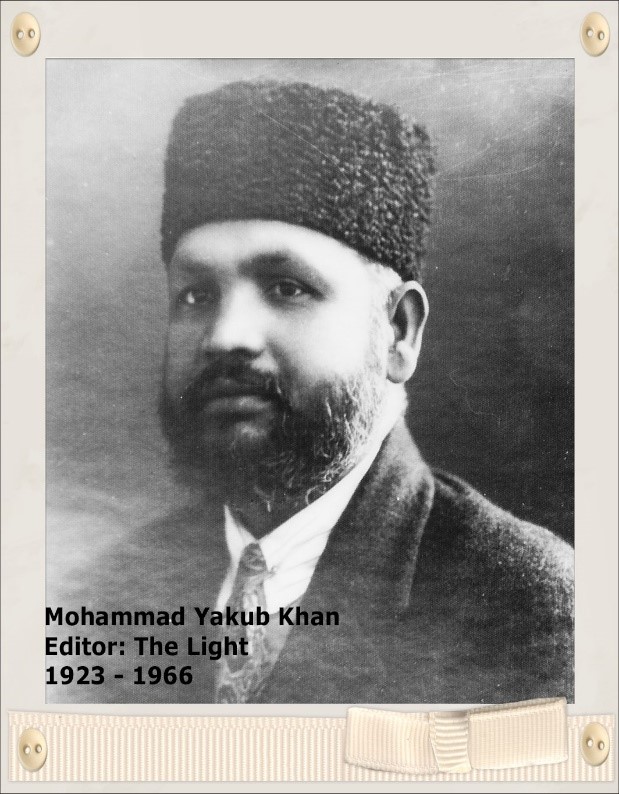
(The Light -August 8, 1960)
(To be continued)