God Is – Part 1
 It was with no small interest that we turned to the perusal of an article on this topic in the current number of Young India from the pen of Mahatma Gandhi. This is a Godless age. To talk of God in these times, especially in a society of educated people, is to invite ridicule. Even Mahatmaji’s references to God in Young India was not spared and he tells us, they are characterized as “God stunt”. We have a similar experience of our own. Friends and admirers who wish to help forward our circulation often take us to task for the religious appearance of the paper. “You give us such up-to-date and uplifting ideas in your columns,” they tell us, “but you spoil the whole thing when you call them religion.” One particular friend still insists on our removal of the title-block on the front page, which contains some Quranic verses. “Your articles are so good and I am sure of making subscribers of my friends but the moment they look at the وَاللّٰہُ مُتِمُّ نُوۡرِہٖ وَلَوۡ کَرِہَ الۡکٰفِرُوۡنَ stunt, the verse at the top, they fling it back at me in disgust. They are sick of religion and anything that smacks of it simply gets on their nerves.” The other day we came across a very queer characterization of religious-minded people in the columns of a London paper. Under the caption “Tailed Minds” it was discussed how every human skeleton still ends in a tiny projection at the back, a relic of the tail which our animal ancestors actually possessed. And just as these tiny of tails are reminiscent of our animal origin, likewise in regard to mentality, there are superstitions which we have inherited from ancient times and which still cling to us. These superstitious beliefs are, so to speak, our mental tails in as much as they remind us of the irrational animal outlook of our remote ancestors. It is thus no easy task to hold a brief for God in these days when every second man you meet would simply scoff at you, should you have the courage to touch on the unwanted topic. Our curiosity to see what light this greatest man of the day, Mahatama Gandhi, has to throw on this age-long question of God may well be imagined. While reserving our own humble contribution to the unraveling of this eternal mystery for our next issue, we believe we must treat our readers to the Mahatama’s views on the question in extenso. The personal testimony of a man of Mahatama’s position is well-worth reproduction and may strengthen someone small in faith somewhere. This is what he says:-
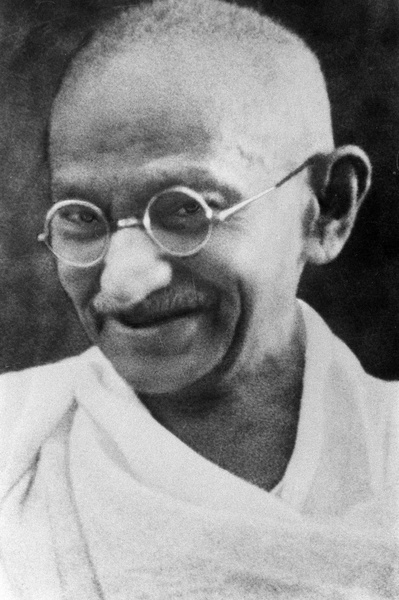
Mohatma Gandhi
“The argument is as old as Adam. I have no original answer for it. But I permit myself to state why I believe. I am prompted to do so because of the knowledge that there are young men who are interested in my views and doings”.
“There is an indefinable mysterious Power that pervades everything. I feel it, though I do not see it. It is this unseen Power which makes itself felt and yet defies all proof, because it is so unlike all that I perceive through my senses. It transcends the senses”.
“But it is possible to reason out the existence of God to a limited extent. Even in ordinary affairs we know that people do not know who rules or why and how he rules. And yet they know that there is a power that certainly rules. In my tour last year in Mysore, I met many poor villagers and I found upon inquiry that they did not know who ruled Mysore. They simply said some god ruled it. If the knowledge of these poor people was so limited about their ruler I, who am infinitely lesser than God than their ruler need not be surprised if I do not realize the presence of God, the King of kings. Nevertheless, I do feel as the poor villagers felt about Mysore that there is orderliness in the Universe, there is an unalterable Law governing everything and every being that exists or lives. It is not a blind law; for no blind law can govern the conduct of living beings and thanks to the marvelous research of Sir J. G. Bose, it can now be proved that even matter is life. That Law then which governs all life is God. Law and the Lawgiver are one. I may not deny the Law or the Lawgiver, because I know so little about it or Him. Even as my denial or ignorance of the existence of an earthly power will avail me nothing, so will not my denial of God and His Law liberate me from its operation; whereas humble and mute acceptance of divine authority makes life’s journey easier even as the acceptance of earthly rule makes life under it easier.
“I do dimly perceive that whilst everything around me is ever changing, ever dying, there is underlying all that change a living power that is changeless, that holds all together, that creates, dissolves and recreates. That informing power or spirit is God. And since nothing else I see merely through the senses can or will persist, He alone is”.
“And is this power benevolent or malevolent? I see it as purely benevolent. For I can see that in the midst of death life persists, in the midst of untruth truth persists, in the midst of darkness light persists. Hence, I gather that God is Life, Truth, Light. He is Love. He is the supreme Good”.
“But He is no God who merely satisfies the intellect if He ever does. God to be God must rule the heart and transform it. He must express Himself in every the smallest act of His votary. This can only be done through a definite realization, more real than the five senses can ever produce. Sense perceptions can be, often are, false and deceptive, however real they may appear to us. Where there is realization outside the senses it is infallible. It is proved not by extraneous evidence but in the transformed conduct and character of those who have felt the real presence of God within”.
“Such testimony is to be found in the experiences of an unbroken line of prophets and sages in all countries and climes. To reject this evidence is to deny oneself”.
“This realization is preceded by an immovable faith. He who would in his own person test the fact of God’s presence can do so by a living faith. And since faith itself cannot be proved by extraneous evidence, the safest course is to believe in the moral government of the world and therefore in the supremacy of the moral law, the law of truth and love. Exercise of faith will be the safest where there is a clear determination summarily to reject all that is contrary to Truth and Love.
“But the foregoing does not answer the correspondent’s argument. I confess to him that I have no argument to convince him through reason. Faith transcends reason. All I can advise him to do is not to attempt the impossible. I cannot account for the existence of evil by any rational method. To want to do so is to be coequal with God. I am therefore humble enough to recognize evil as such. And I call God long suffering and patient precisely because he permits evil in the world. I know that He has no evil in Him and yet if there is evil, He is the author of it and yet untouched by it”.
“I know too that I shall never know God if I do not wrestle with and against evil even at the cost of life itself. I am fortified in the belief by my own humble and limited experience. The purer I try to become, the nearer I feel to be to God. How much more should I be, when my faith is not a mere apology as it is to-day but has become as immovable as the Himalayas and as white and bright as the snows on their peaks? Meanwhile I invite the correspondent to pray with Newman who sang from experience:
‘Lead, kindly Light, amid the encircling gloom,
‘Lead Thou me on;
‘The night is dark and I am far from home,
‘Lead Thou me on;
‘Keep Thou my feet, I do not ask to see
‘The distant scene; one step enough for me.”
M.Y.Khan (THE LIGHT October 18, 1928)